2020s
Daily Review - The Necks
Published: 2020-02-25
The Necks RCC Level 5 Union House, University of Adelaide
February 21.
In the house of the Adelaide Fringe there are many mansions. Venues spring up all over the CBD each with distinctive programs and loyal audiences. In the East End, The Garden of Unearthly Delights at Rundle Park and Gluttony at the adjacent Rymill Park attract huge crowds for the four weeks of Fringe activity. The Holden Street Theatres at Hindmarsh have a first-rate program, curated by director Martha Lott, many of them freshly-imported headliners from last year’s Edinburgh Fringe.
And at Adelaide Uni, for a second year running, RCC (no longer known as the Royal Croquet Club) has benignly commandeered the campus for a rich range of events, programmed by former Adelaide Festival director, David Sefton.
Over four festivals Sefton hosted outstanding contemporary music with residencies from John Zorn and Gavin Bryars, performances by Kronos Quartet, Laurie Anderson and Van Dyke Parks, post-rock musicians such as The National and Godspeed You ! Black Emperor and many others in the Unsound Adelaide programs.
To last year’s RCC he brought Pussy Riot and the Ziporyn
Ambient Orchestra and this time his program features Stereolab, Lydia Lunch Retrovirus, A tribute to the Lost Songs of the Triffids singer David McComb, a recital of Steve Reich’s Music for 18 Musicians and a one-night only performance from The Necks.
Formed in 1987, The Necks have gained an extraordinary reputation not only in this country but enjoy a devoted following in Europe and North America as leading exponents in ambient improvised performance. Dissolving the boundaries between jazz, electronica and minimalist chamber music The Necks are as distinctive as they are unique.
Over more than twenty albums, this trio – featuring Chris Abrahams on piano and Hammond organ, Tony Buck on drums and percussion and Lloyd Swanton on electric and double bass – has explored a variety of musical territories. From their debut CD Sex to their haunting soundtrack to the grimly brilliant film, The Boys in 1998, the catchy beats of Drive By in 2003 to current studio work such as last year’s Three, The Necks have established and sustained a remarkable output for their ubiquitous Fish of Milk label.
On stage in the makeshift Level 5 space in Union House the group prepares to play to a capacity crowd braced for a night of original sounds and maximum invention. With a total lack of fanfare the musicians take up their instruments. No greetings, no introductions, they settle into the meditative positions they hold for the entire evening.
Abrahams begins with small slow chords on the piano, trickling, lightly-syncopated repetitions. Lloyd Swanton, head bowed, holds his double bass as the piano lightly explores its motif. Almost imperceptibly, Tony Buck brushes the cymbals. It is tiny and tentative and the audience is drawn in like moths to a very pale flame.
The music just appears as if conjured from the air. It is said The Necks begin with a blank page. It is perhaps a tabula rasa. Or raga more like, because their work invites comparison with the Indian carnatic improvisations of Ali Akhbar Khan, the violinist L. Subramaniam and so many others seen and heard on the WOMAD circuit and in Indian festivals.
The players begin to develop motifs and modal loops. Abrahams’ mellow harmonic chords now joined by Swanton’s sweeping bowed bass lines which then turn into a repeated plucked pulsing bass. Buck is mixing a soft bell sound with his cymbal brushes. The sound is soothing, intriguing and is quietly gathering. We are at the 16 minute mark and this music morphs and changes, ebbs and flows, in small incremental steps.
The musicians are entirely absorbed in their playing, looking down into their work. Abrahams, methodical and restrained at the acoustic piano, Swanton puttering and bowing the intricate and insistent bass line and Buck finding ways to scrape and agitate the drumhead while developing an insistent brush and timpani mallet rhythm that begins to drive the composition past the 28 minute mark. Unlike so many bands, the players never exchange glances or visibly share ideas. There is neither a nod nor a wink. It is solemn and intensely concentrated. The audience leans in even further.
By 36 minutes the music is now a series of swells and disturbances. It is hard to know where these changes have come from. We are watching every step but these shifts elude detection. The music keeps becoming before our eyes but we catch each change too late . It is strange and engaging, like watching an eclipse and somehow blinking just as the celestial bodies move into unison.
The intensity gets greater and you start to feel unhinged. The insistence is disturbing. I find myself both enjoying the constant threading and looping and wanting it to ease up, to exhaust these repetitions and disperse. But it is 48 minutes now and there is a dervish-like twirl and rapture to the rhythmic piano thrumming its tattoo, the bass lines are coming up from the floorboards and the drumming rattles and beats in fast march time. At 52 minutes the music stops as suddenly as it began. The musicians briefly bow and leave the stage. Swanton announces a 20 minute break before the second set returns.
And the players resume a second time for 44 minutes - even more focused and inventive than before. Each musician is subsumed in the collective sound. No solos, no leads, no ego, no hi-jinx. There are other musicians who chart this territory. Can from Germany for instance, Brian Eno in his studio constructions. The long career of Keith Jarrett is a journey into melodic and harmonic labyrinths, some whimsical, some sublime and some perverse. But there is something austere, Zen-like and instinctively apt about the way with The Necks do things. They have discovered a music that is located somewhere between the head and the heart - and whichever way you turn, it is a fascinating place to visit.
Five Stars
Daily Review, February 25, 2020.
Daily Review - WOMADelaide 2020 Returns to Botanic Park
Published: 2020-03-03
Director Ian Scobie talks with Murray Bramwell about Adelaide’s most enduring international music event.
This coming Friday, March 6, marks the opening of the four day WOMADelaide music festival. With its odd portmanteau name (WOMAD is an acronym for World of Music and Dance) the South Australian version of the UK festival, originally founded and promoted by Peter Gabriel, began as part of Rob Brookman’s Adelaide Festival in 1992.
There have been 23 festivals since then – it became an annual fixture in 2003 and a four day event in 2010. Since 1995 the organisation has been managed by APA (Arts Projects Australia) and the current director, Ian Scobie is the sole remaining original member of the APA team.
As WOMADelaide approaches its 30th anniversary, I asked Scobie what he considers the secret, not only of the festival’s success, but also its longevity. He talks about the great advantage of having unique access to Botanic Park, a green oasis right in Adelaide’s CBD with ample roaming space for 12,000 people at any one time as well as seven different performance stages.
“We are lucky with WOMAD. Firstly it’s in a city that is familiar with the idea of festivals. It has drunk the festival kool-aid. People have grown up with it. It is real and palpable. And the Events SA funding is absolutely rock solid. I talk to colleagues interstate and know its hard yakka without funding confidence. We can talk to people three years in advance knowing that the funding and infrastructure are in place. I can see things and plan. I don’t have to convince a board and so on
The festival also offers a carefully managed experience for both artists and audiences. Scobie sees this as an international WOMAD characteristic, whether the UK, Europe or New Zealand version.
“It is interesting. Ziggy Marley (one of the 2020 headliners in Adelaide) played at WOMAD UK last year. He was impressed. He got it. Being in a like-minded audience and out of the rock and roll thing of ‘arrive in town-practice-put on a show-leave’. Artists universally respond to WOMADelaide in such a positive manner. They love the city, they love the park, they love the markets. It’s great.”
It is also a factor that the festival began as part of the Adelaide Festival where the etiquette of hospitality was a key feature of Writers Week and the performance program generally.
“I remember the director, Clifford Hocking, giving me the 101 lesson when I worked with him on the Adelaide Festival. That was - to remember that you are inviting people to be a guest in your home and essentially you need to understand that they are feeling nervous, they have travelled a long way. They need to feel welcome and looked after.
“Their technical requirements will be met - but more fundamentally there is a level of respect for them which puts them in the best frame of mind to do their best work. Then it will be received well. And if that’s not the case, then all this other human static gets in there – and people don’t feel looked after.
“I have the same view of our audience. You have 20,000 guests who are invited to your backyard for a party. You want to make sure they are comfortable and there’s shade, because if all those basic things aren’t there you have missed the point – if people aren’t comfortable and can’t hear. You want to get rid of all that.”
The 2020 WOMADelaide has some big names coming home to roost. Celebrated Malian griot singer Salif Keita revisits for a fourth and perhaps final time, esteemed US gospel singer and civil rights activist, Mavis Staples, is also returning after her splendid set in 2008 with her exceptional We’ll Never Turn Back album.
Twenty years on, early festival favourites The Cat Empire will play the 10 pm spot on Friday night. The remarkable Blind Boys of Alabama – a musical organisation founded in 1939 and rejuvenated in the 21st century with collaborators such as Robert Randolph, Ben Harper and Marc Cohn - also feature on the opening night. Frequent WOMADelaide highlight, Indian classical violinist L.Subramaniam will perform during the day on Saturday and for a seated event on Sunday night.
Scobie is especially pleased to program Ziggy Marley. “He’s not singing his dad’s hits. He’s a reggae performer in his own right. He’s another generation and he’s very positive. ‘Love will solve the world’s problems’. It is a great attitude to have. It’s a joyous show. “
I ask him how the program is compiled and he explains it is a joint venture. “It is between two and a half of us,” he says cryptically.
“It is between (Operations and Program Manager) Annette Tripodi and me in Adelaide, and Paula Henderson from WOMAD UK. She worked on the first WOMADelaide in 1992. We have worked together on and off over a long time. We have a sympatico understanding, a shorthand. Paula sees something and says ‘that will really work in Adelaide’. She’s our UK eyes. It is a collaboration between us and the UK, so there a lot of to and fro. It’s a mosaic, a puzzle, getting the pieces to fit.
“I think the festival experience for the patron needs to be discovery, surprise, some old friends, some beautiful music and great artists. They have to be at the right level. We’ve had some interesting examples of artists who were not quite ready- and then they are. Annette will sometimes suggest something and it’s not the top of my list. But it’s not my festival- and that’s a fundamental difference from other festival models.
“The curatorial role is that you are responsible for a cultural collection in a gallery, rather than picking favourites. You don’t have a program full of work from just one country, you need light and shade. Every time you program a slot there’s one less opportunity for something else. Sometimes finding a group from Timor or Malaysia is way of sharpening the experience. Ideally, I like the festival to have quite a few things that are a new thing to me as well – rather than same, same. “
I ask Scobie which selections he is particularly pleased with and he begins to thumb the brochure for examples. Floating Flowers, a dance work from Taiwanese company B. Dance, led by director /choreographer Po-Cheng Tsai, springs to mind.
“They were a classic last-minute surprise. I saw about 20 minutes of Floating Flowers in passing in Edinburgh and thought ‘this is extraordinary.’ I gave them my card and said ‘you must come to WOMAD.’
“Ustad Saami from Pakistan (a practitioner of a vocal style dating back to the 13th century) He’s special. His voice is exquisitely transporting but it has a rasping quality. It’s not like Nusrat (the late Nusrat Fateh Ali Khan , WOMADelaide legend from the original 1992 festival). It doesn’t pick you up in a warm blanket and take you, but I found it unusual and a real force.
“Every time I have pushed the envelope the audiences have lapped it up. I think programmers can be too cautious. The public has bought a ticket for an experience . They are up for it. They don’t just want familiar pop. “
Other selections he singles out include Ifriqiyya Electrique from the Maghreb (historically known as Ifriqiyya) the region of North West Africa consisting of Algeria, Libya, Mauritania, Morocco, Tunisia and Western Sahara. Their concert experience has been described as a combination of Afro-Tunisian ritual trance and Western post-industrial punk. Their most recent album is entitled Laylet El Booree.
The eleven piece Malaysian group, Orang Orang Drum Theatre also rates a Director’s mention: “I saw them and they were young and enthusiastic. Energised and keen to present their cultural story which I think is fantastic. We are programming a whole new generation of musicians.”
Which leads to Scobie to talking about Scottish performer Kathryn Joseph whose music he describes as a cross-over with performance art. Her first album, Bones You Have Thrown Me and Blood I Have Spilled, won Scottish album of the year in 2015. Her second recording From When I Wake The Want Is, released in August 2018, is compelling to listen to. Her plaintive, trickling piano aptly matching her burred vibrato vocal. The arrangements with percussion and discreet electronica complete the effect.
With her long, thick hair and crofter funk outfits she is imposing and other-worldly. An original like Kate Bush or Bjork, she is also re-invigorating Scottish folk traditions. Kathryn Joseph plays twice, Saturday and Monday – both times at the Moreton Bay stage. Check out her BBC Scotland live sessions on YouTube. She is not to be missed.
Women musicians are always well represented at WOMADelaide and in 2020 the calibre of their contribution is especially evident. The list is extraordinary. Harpist, Catrin Finch (duetting with kora player Seckou Keita) will play a fusion of Welsh traditional music and Senegalese Mandika rhythms.
Other outstanding performers to check out are the spectacular PNG/Australian Ngaiire, whose terrific recent album, Blastoma is worth checking out. UK contemporary folk songwriter Laura Marling, whose recordings have been nominated for Mercury Awards and a Grammy, will perform once only on Monday.
Aldous Harding has for a time now been a WOMAD NZ favourite and played Laneway Festival in Adelaide several years ago. Finally she gets to play Botanic Park. Like Kathryn Joseph, she is in the Joanna Newsom vein. A mainstay of the thriving Lyttleton music scene outside Christchurch, New Zealand, Harding has two excellent albums. The first, self-titled, with songs such as Stop Your Tears, Hunter and Titus Alone and her more recent CD, Designer. She has one concert only at 5.15 on Saturday.
The unique Kate Miller-Heidke, featured in the current Adelaide Festival’s extraordinary Virtual Reality installation Eight in collaboration with Michel van der Aa, will perform just once time, on Friday night.
Other women artists to watch out for include Luisa Sobral from Portugal, singing from her newest album Rosa, dedicated to her young daughter; the five member Mexican group Flor de Toloache; the talented Indigenous singer, Deline Briscoe showcasing her excellent Wawu album; and acclaimed US traditional country performer Rhiannon Giddens, blending her Appalachian and minstrel fiddle and banjo sounds with Francesco Turrisi on the Sicilian tamburello. There are more – Marina Satti and Fones, Gelarah Pour’s Garden from Iran, Spinifex Gum from the Pilbara country and Korean exponent of the double-headed Janggu drum, Kim So Ra.
WOMADelaide is also a showcase for visual art works, dance, French strolling theatre from Company Archibald Caramantran, the virtuoso acrobatics of Gravity and Other Myths and, featured each night in Frome Park, As the World Tipped from the UK based Wired Aerial Theatre, presenting spectacular high flying movement in sync with massive projected images highlighting the very real and present danger of climate change.
This presentation could not be more timely after a summer of ferocious bushfires, wildlife and habitat devastation, and an urgent need for cogent scientific public advocacy against the continuing obstinacy of government and vested interests.
Last year, Ian Scobie admits he was worried that As The World Tipped “would be passé because of the breakdown of the Copenhagen talks. But it is now very current. There will be references to the United Nations IPPC Report on climate change and a coda with a recorded message from Greta Thunberg.
The Planet Talks forums will continue the WOMADelaide tradition with speakers on sustainability, climate change, big tech and data ethics, politics, transformative change and sleep research.
I ask Scobie if, after so many WOMADs in a row, it has become a routine thing. His reply :
“I do love it still. I have my moments, of course. But then I see something and think ‘I’ve got to have that.’ The French Gratte Ciel company’s Place des Anges in 2018 was an example. Of the things I saw last year, Kathryn Joseph was one , Floating Flowers another.
“I remember things I saw in the Adelaide Festival. Peter Brook’s The Ik and Pere Ubu at the Quarry back in 1980. Having those moments is key. And I think it is for our audience. You have to find those things which are a part of cultural memory and people’s lives. And they look back and say ‘do you remember that time ?’ Part of the task is to have those WOMAD peaks. That ‘wow’ moment, that full stop, or exclamation mark, is why culture matters. It makes you stop and think. It gives you that space in your soul.”
WOMADelaide opens March 6 until March 9. Botanic Park, Adelaide .
Daily Review. March 3, 2020.
Adelaide Festival - 150 Psalms
Published: 2020-03-04
150 Psalms Leadership (Concert 9) Pilgrim Church, Flinders St. March 2.
150 Psalms, a choral presentation of twelve themed concerts performed over four days, is one of the centrepieces of the 2020 Adelaide Festival as it celebrates its 60th year. It is an extensive project, conceived by Tido Visser, managing director of the Netherlands Chamber Choir, and was first performed in 2017 at the Utrecht Festival Oude Muziek.
The Adelaide event is its fourth version, featuring The Netherlands Chamber Choir, The Norwegian Soloists’ Choir, The Tallis Scholars and, from Australia, The Song Company.
Each of the concerts has a theme. From one to twelve they are:
A Mirror for Today’s Society, Trust, Safety, Justice, Abandonment, Gratitude, Powerlessness, Suffering, Leadership, Path of Life, Power and Oppression and Celebration of Life. These are divided up among the choirs, except for the final concert - featuring all of the singers in the project. Venues are spread around the city and among religious denominations – St Peter’s Cathedral, the Adelaide Hebrew Congregation in Glenside, St Xavier’s Cathedral, Pilgrim Church and, for a secular conclusion, Adelaide Town Hall.
Leadership, ninth in the series is a midday concert at Pilgrim Church. As we line up for the event, Amnesty International volunteers are collecting signatures against off-shore refugee detention. Amnesty is a co-sponsor of the 150 Psalms event. Each concert is also prefaced by a speaker.
For Leadership, it is Francis Sullivan, former CEO of the Truth, Justice and Healing Council from 2012 to 2018. They were responsible for co-ordinating the response of the Catholic Church throughout the Royal Commission into Institutional Responses to Child Abuse. He describes it as “the gig from Hell.”
So often we associate notions of leadership with authority, command and delegation. Sullivan’s emphasis is on pausing to listen, in not rushing to judgement. An instinctive response, he observes, is not an intuitive one. To pause and consider, instead of resorting to defensiveness and denial, these are the virtues.
It is a simple and direct account he gives of paying attention – to stories of concealment, of people “disbelieved, disparaged and discarded.” One person at the hearings said to Sullivan – “Don’t you dare let us down again.”
Francis Sullivan concludes with a description of a kind of pilgrimage he made, after the Commission concluded, along the Camino Walk to the Santiago Cathedral in Spain. A Catholic himself, he decided to take with him a copy of the published report of the Commission which documented more than 5000 instances of child abuse. He describes dodging the church security and hurling it into a Cathedral crypt so it landed face up among the ecclesiastical bones. It was a startling gesture of protest and admonition, but also of atonement.
It is an unexpected prologue to the concert and it enhances what is to follow. The Psalms sung in Latin, English and German have been framed by a reminder of the Christian values of conscience and justice for others, not a preoccupation with the piety of the self. It invigorates the Psalms with purpose and duty of a more immediate kind.
The twelve psalms chosen range from the 16th century to the present. It is Thomas Arne’s (1710-1778) sprightly setting for Psalm 2 which opens the event. Under conductor, Antony Pitts, The Song Company, founded in 1984 and based in Sydney, immediately captivates the full and appreciative pews at Pilgrim Church. With twelve members – six women, six men – they quickly confirm the view that this is the country’s pre-eminent choir and a capella ensemble.
Psalm 45 by Francisco Valls (1665-1747) sung in Latin by six of the company, is as glorious as it is brief, while young 33 year old composer, William Knight’s rendering of Psalm 21 - “He asked You for life/ and you gave it to him” is majestic.
There are two works in German, late 19th century composer Felix Draeseke’s Psalm 93- Der Herr ist Konig and 18th century musician Johann Heinrich Rolle’s Psalm 97. The full choir performs the brief and lovely fragment from William Byrd (1543-1623) from Psalm 94. Translated from the Latin it reads: “O Lord, according to the multitude of sorrows in my heart/Thy consolations have made my soul joyful.”
A highlight is Psalm 96, A new song, by James McMillan (b. 1959) featuring male voices only and concluding with a triumphant organ solo from Anthony Hunt. The final items – from the 18th century, William Boyce’s Psalm 99, The Lord is King, be the people never so impatient and the Robert White (1538-1574) setting in Latin of Psalm 20, reveal the strength and beauty of The Song Company’s prodigious vocal talents - the final “amen” enthralling even the non-religious in the audience, even the lost and gone before.
It has been a splendid recital. My only regret is that I witnessed only one of twelve in this magnificent project.
Adelaide Festival - Eight
Published: 2020-03-05
Eight by Michael van der Aa. Featuring Kate Miller-Heidke, Livia van den Bercken, Vakil Eelman Hetzel Lecture Theatre, Institute Building State Library of South Australia. February 27. Until March 15.
When we talk about immersive experience increasingly we mean Virtual Reality. VR is not only the newest frontier, it the most mind-bending kingdom of them all. Netherlands composer and director, Michael van der Aa has gained prominence for his progress in merging music and visual experience to create art works that go beyond tentative gimmickry.
Eight, his fifteen minute VR composition, featuring Australian singer Kate Miller-Heidke, premiered at the Aix-en-Provence festival in July last year. Van der Aa describes the work as “An audiovisual poem- The life of a woman, a stream of memories, a journey through time.” It has music specifically composed for the VR format and is a collaboration with VR set designer Theun Mosk and, pioneers of the format, The Virtual Dutch Men.
The Hetzel Lecture Theatre, in the heritage Institute Building of the State Library, is an unlikely place to find futuristic music technology. But at the desk a person is waiting to usher me into the mysteries of VR. The starting times are staggered so we enter the event one person at a time.
There are safety questions about health conditions – cardiac, hearing issues, epilepsy, for instance. And phobias. Claustrophobia and vertigo. I nod and try to look sanguine, then sit and wait a while.
The next stage is through the dark curtain to the waiting room. It is quiet and dimly lit. Another person is standing in front of a console. I am given a laminated sheet with song lyrics on it. I read it several times but not much of it sinks in. Maybe I am still wondering about the safety questions. The words – “I sigh/ I hear time falling/ my breathing happens/- it’s not mine” – linger. As does – “the silence of the house touches infinity.”
After what seems quite a long de-compression time. I am called to be fitted with stereo headphones and VR headset. I move the set so the vision is clear – the word Eight, like a dagger, appears before my eyes.
My instructions are to follow instructions. Do as the woman guiding me indicates. And, if I have any problems or concerns, raise both hands above my head and someone will come and attend to me.
As I step to the edge of the white path, it is all go. On each side of me is white elasticised curtaining but already my whole vision is taken over with an image, a hologram of Kate Miller-Heidke who is beckoning me to follow. Already my headphones are filled with sepulchral music. It is Kate’s bell-like mezzo-soprano voice.
The song is Mirrors at Night with choral harmonies from The Netherlands Chamber Choir and minimal instrumentation - so appealing that I later went straight to iTunes to buy the album, Time Falling, which has only just been released.
But at the time I am too busy concentrating on staying in spatial relation with my guide. Several times I turn and seem to move straight through her arm. I don’t feel entirely steady and I know I can’t lean against the soft walls of this cocoon I’m in.
The corridor we are moving along seems all fine and the music is starting to register. “There’s something flowing/ that I can’t grasp/ A man on a terrace/ accidentally falls.” I have no idea what the relation between these words and the sudden changing of the VR landscape is, but it is definitely a portent .
Then I step out into a vast open space. It is like stepping into all of Finland. Or a trippy version of Yellowstone National Park. There are huge dark trees, rocky outcrops, and, as I look out, I realise that I am looking into a canyon. I’ve lost track of my guide. There is a safety rail ahead of me but it melts in my hand. The path I’m on looks like the size of a bath mat. I am standing with my arms wrapped around myself trying not to topple. It is an amazing vista and impressively real, but all I can think about is not being that man on the terrace – accidentally falling.
I feel like Wile E Coyote on a mesa, a thousand metres above the ground, with a rope and an Acme anvil under my arm and any minute the Road Runner is going to honk me and gravity will take me down to that inevitable puff of dust and disintegration.
As I recall (no reviewer’s notes are possible in VR) the images then change to huge rolling asteroids and a yawning chasm of even more intergalactic proportions. That too fades and I am being beckoned by Kate again - and moved into an area which, at least, seems like it has a sensible-sized floor.
There is a table with a cloth over it like a curtain. Under the table is a young girl signalling me to sit with her while she sings another Time Falling song – Identical Hands. It’s good to lower my centre of gravity but my level of apprehension is too high to stay in the moment.
The next audiovisual torment is a blizzard of red stars which expands into another vertiginous revelation. There is another sheer drop and the swirling red particles seem to be inviting me straight over the edge. I think about raising my arms in the air and then decide not to. I probably stood stock still for less than a minute but it seems like infinity. Frozen to the spot, not moving a muscle, not even a chromosone. So I don’t fall a thousand metres into the Earth’s core in the Hetzel Lecture Theatre.
From there, Kate returns one last time - and then an actual human tells me to come to the end of the lit path and my apparatus will be removed. I hand back my headphones and VR set and try very hard not to kiss the ground.
The final lines of the song I have just heard are loaded with irony when I read them again days later. “Turn backward/ turn backward/ From the silence, the hollow, the untrue/ once again/ We are in no particular point in time.”
Eight is an extraordinary experience, visually and musically, but for me an unnerving one. The components of the narrative – the woman moving back from age to childhood – are lost in sheer alarm at falling into the VR abyss. I should have paid closer attention to the fine print. Extreme vertigo. I think that’s me.
Eight - FOUR stars
Your Correspondent- No Stars whatsoever.
Adelaide Fringe - Truckload of Sky - The Lost Songs of David McComb
Published: 2020-03-18
Truckload of Sky - The Lost Songs of David McComb The Friends of David McComb Level 5, Union House, The University of Adelaide. RCC . March 12.
Formed in Perth in 1978, after morphing from a band called Dalsy and (name-for-a-day) Logic, The Triffids produced five studio albums, six EPs, six live recordings/ compilations and nine legendary cassettes including Dungeon and Son. Singles such as Wide Open Road and Bury Me Deep in Love became etched in the Australian national songbook, but although indie favourites, the Triffids never really had their day.
When they went to the UK in 1984, by January of the next year the cover of the influential New Musical Express proclaimed –“The Year of The Triffids.” But somehow fate threw saltwater on their fortunes, and like NZ band The Mutton Birds, despite critical enthusiasm, the wider following failed to materialise. By 1989, this excellent band, led by an extraordinarily talented singer songwriter, had called it quits.
As time passes, the life and works of David McComb only seem more remarkable. Prolific, distinctive, and startlingly assured, McComb conjured haunting, memorable lyrics and found riffs, hooks, bridges and choruses that fitted like melodic gloves. He had written hundreds of songs by the time of his tragic and early death, at 36 in 1999. We can only wonder at what might have been. Even now, his output is only surpassed by Paul Kelly and Nick Cave, two celebrated survivors of the same years of living dangerously.
The Friends of David McComb is a fine name for a terrific project.
Comprising fellow Triffids – his younger brother, Rob McComb, pedal steel wiz Graham Lee, and bassist Phil Kakulas- as well as Blackeyed Susans lead singer, Rob Snarski and guitarist JP Shilo, drummer Clare Moore (Moodists and Dave Graney Band) keyboard maestro Bruce Haymes and vocalist Alex Gow, their performance at RCC’s Level 5 is the first live outing of an album of Lost Songs released only this month.
Truckload of Sky is a collection of songs from the trove of McComb’s unreleased material. It is a rich find, and nothing like the usual bottom-drawer out-takes that get added to the legacy of many musicians. This is top-drawer stuff and, at last, we are getting to hear it.
On stage to sing the first cluster is Rob Snarski, said to be McComb’s favourite singer, for whom he wrote Ocean of You. Snarski’s fine baritone and phrasing captures it – “I’m out of my depth in an ocean of you.” Haymes’ piano tracks the vocal, along with Lee on pedal steel. Kiss Him (He’s History) is McComb at his ironic poignant best and Snarski delivers. These songs are like revelations, overdue to be heard.
Second Nature also has a melancholy tinged with spite – “It’s second nature to hurt someone/ Simplest thing is to treat them like dirt/ Comes in the blood it’s in the water supply/ Second nature second nature to hurt.” These are not moon-and-june lyrics or panegyrics to a sunburnt country. This Australia is mean and unexamined. Wake in Fright with an unsettlingly jaunty country twang.
For Make Believe We’re not here in Hell (McComb’s titles sound like Tennessee Williams) the singer is Alex Gow (it’s Romy Vega on the CD) accompanied by the steadfast bass of Phil Kakulas, Clare Moore’s slow march drum and Graham Lee on heartbreak pedal steel. Gow also croons through Look Out for Yourself (nobody else will) a slow blues inhabiting that wry McComb space that is neither self pity or bravado. The band are getting into stride – Rob McComb moving between violin and a Gretsch with a tasty effects switch, JP Shilo up the back on lead guitar and Haymes finding just the right fills and harmonies. Kneel so Low is another sardonic uncovered treasure and Gow completes his excellent stint with a Triffids fave - No Desire.
Peerlessly accompanied only by Haymes and Lee, Snarski returns with This One Eats Souls – with its haunted lyric it is one of McComb’s finest songs and Snarski, singer for the erstwhile Blackeyed Susans, captures it better than ever. It is a highlight among many. Snarski follows with a more upbeat Christmas song – I’ve Heard Things Turn Out this Way.
Singer guitarist JP Shilo brings some grunt to Don’t Call Yourself an Angel and then – who knew the bleak irony of the week to follow? – This Whole World’s About to Slide with its fearful lyric – “Growing something strange in the back of my eye/ Have to hold me down / with a truckload of sky/This whole world’s about to slide / Yeah this whole world’s about to slide.” Enemy Mine and Lucky for Some close JP’s set and Snarski duets with Lenore Stephens in the otherworldly Somewhere in the Shadows.
It has been a full set – twenty songs, some favourites, most brand new to all of us at Level 5. The Friends finish loud and strong for Raining Pleasure, Unmade Bed and (with a lyric worthy of John Donne) A Trick of the Light. It has been a celebration of fine music but it is elegiac as well. These musicians knew and worked with David McComb. One of them is his brother. Twenty years have passed but his presence is everywhere. It is not a trick of the light, and it brings a truckload of sky.
Postscript. This concert was to be the first of a tour of Melbourne, Brisbane, Sydney and Fremantle in April and May. With the Covid19 crisis some of these are certainly cancelled, others doubtful. I hope, like everything else, that this is only temporary.
Murray Bramwell
The Barefoot Review
Published: 2021-02-23
WOMADelaide 2021: Re-inventing for the Pandemic
Murray Bramwell talks with Artistic Director, Ian Scobie about the challenges of planning a music festival during COVID.
The last time I interviewed Ian Scobie about WOMADelaide it was late January last year and Kangaroo Island was burning down. The bushfires -which engulfed huge sections of the country, sending serious smoke haze into the cities - were on everyone’s mind. Scobie’s company APA was running a national tour for the Italian composer, Ludovico Einaudi, who was due to perform at the Myer Music Bowl. It was uncertain to happen because of poor air conditions. Fortunately, the smoke dispersed and the concert went ahead.
But nothing matches 2021. As Scobie describes it :
“It’s been very, very challenging really. I have to say that since working in Festivals-land since 1984, you come across the usual challenges – air traffic control for Peter Brook’s The Mahabharata at the Quarry, or suddenly finding a tented venue has a third of the capacity it is supposed to have.
“But this is a whole kind of other degree of uncertainty – which, of course, the whole world is dealing with, it’s not just poor us. It’s the constant uncertainty that’s so different. When we found out we couldn’t get a permit to do the full scale event we had to ask ourselves – ‘Do we do anything, or just cancel ?’
“The decision came very late in the year. We were meeting with SA Health in some detail from June 2020 onwards and we were backwards and forwards discussing ways of dealing with the situation and avoiding over-crowding. We were maintaining parallel programs - an international one if things got better, and then an Australian one. By late August we thought international was unlikely so by September it was going to be a program sourced within Australia. We had that arranged, with the diversity one would expect - culturally and musically.
“It was then not until the second week in October when, after more back and forth to SA Health, they said – ‘Mmmm. No. We just think the combination of the duration, from noon to midnight, and the multi-stage format with audiences crossing over…’ It wasn’t something they were able to support.
“We just had to call it. So then we had to find out from SA Health what maximum event number we could have, and addressing their concerns meant we came to our decision – to have one stage, individual reserve seats, individual tickets not day passes. That meant contact tracing for Person X sitting in C 27 on Friday night or Saturday B 36. The QR app was not introduced yet. “
Scobie consulted with other event organisers such as the Adelaide Oval management –
“They were very helpful and keen to have us use their venue and it is a fabulous stadium. But it’s an oval. It is not really part of the ethos of the WOMADelaide event. Which is how we ended up at King Rodney Park.
“Once we set parameters we had three days to get back to SA Health with a plan for six thousand seats, spaced in a version of checkerboard, a single fixed stage and operating hours confined from 6 pm to midnight. The duration of people’s exposure is reduced and we know who and where they all are. “
At first Scobie considered using Elder Park but it was impossible to establish good sightlines for the size of the crowd. The same held for Botanic Park – the home of WOMADelaide since it began in 1992. Since it is a park full of trees there was nowhere that a seating rig could allow an unimpeded view for more than three thousand which, considering the overheads, was not financially viable. So Scobie and Mark Muller, the production manager, drove around the city looking for possible sites.
“We came across King Rodney Park – bounded by Dequetteville Terrace, Wakefield Road and Bartels Road. It contains an arena, has a fringe of trees, and parkland all around. So you have a sense of arrival and enclosure. It is the Christian Brothers College oval which is owned by the City of Adelaide and leased to the school. It is maintained for sport but open to the public. We have divided the area into zones – two thousand people through each of three gates, with six thousand the capacity. It will have a park feeling and we wanted a sense of enclosure. It will be a different concept but I did have one longtime WOMADelaide supporter say to me – ‘I’m so looking forward to having a seat !’ “
Scobie is pleased with the venue and the arrangements.
“I thought we had an obligation to run WOMAD in some form or other. I was opposed to presenting something like a single concert inside an auditorium that bore no resemblance to the event. I also had a concern that we needed to provide employment for the artists. Here we are in the middle of a pandemic and the arts are the first hit and the most heavily impacted – I think, even more than tourism.”
The 2021 four night concert program, developed by Associate Director Annette Tripodi and her team, is the tip of an organisational planning iceberg that has been busy all year. The 25th WOMADelaide, in its 29th year and one of the city’s most enduring events, will be remembered by the staff as a massive contingency exercise, a carefully constructed framework of events that could have been, but never happened. Scobie observes :
“Annette has done an amazing job. There is a full Australian program that’s never seen the light of day – which would have been terrific. But planning like this may be the future. I do hope we are gong to have a full scale event in Botanic Park in 2022, whether it has an international component, who
knows ? Next year will be a bit of a Groundhog Day with the same uncertainties. We will plan parallel Australian and international programs and see how it goes. Ziggy Marley is keen to come, if we have internationals, he will be in it !”
The Friday night line-up opens, as WOMAD has done often before, with the participation of the Adelaide Symphony Orchestra. They will be ccompanying Lior, another festival favourite, in his performance of Compassion, a song cycle composed and conducted by Nigel Westlake. Commisssioned for the Sydney Symphony, Compassion incorporates texts and themes from both Islam and Judaism. Of the project Westlake has said - “We have tried to imbue the ancient texts with a contemporary interpretation, adhering to the purity of a single voice and orchestra. “
Also appearing is Archie Roach, whose classic album Charcoal Lane featured the anthem of the Stolen Generation, “Took the Children Away”. His music has been re-released in recent years with the box set, Creation, and a remastered version of Charcoal Lane. His performance will be the first of many over four nights, highlighting indigenous culture and issues.
Completing the night’s list is the excellent Sarah Blasko whose ARIA nomination and Triple J Album of the Year, As Day Follows Night, has celebrated its tenth anniversary with a re-issue plus bonus tracks. It sounds fresher than ever and her set will be a great note to close on.
Saturday night is an especially hot ticket and is already heavily subscribed. It opens with young Indigenous rappers MRLN x RKM (aka. Marlon Motlop and RullaKelly-Mansell) new talents sponsored by WOMADelaide and the NSS Academy.
Next is the near legendary Vika and Linda and their outstanding band, and we will be reminded what a strong repertoire they have gathered over a brilliant career. Their ample compilation album, Akilotoa, is impressive, not only for its range and appeal, but also because they are some of the finest interpreters of the songs of long-time collaborator, Paul Kelly.
Headliners on Saturday are Midnight Oil. As Ian Scobie observes:
“Midnight Oil have been regularly on our books and we check them out to ask –what are you doing this time ? They played WOMADelaide in 1997 and Peter Garrett has returned a couple of times to Planet Talks. He has fond memories of that particular gig. They also performed at WOMAD UK going back a way. So there’s always been a connection. We had been talking for 18 months to two years out. They were planned for this year. Nobody thought it would be like this, but it was great to have it in prospect. People thinking – ‘Oh God this is not a traditional WOMAD ! ‘ Instead, they see it’s Midnight Oil and they are also doing their Makarrata Live project on the closing night.“
Sunday night was scheduled to open with Zambian-born singer, Sampa the Great, but she cancelled all Australian commitments because she had travelled to Botswana and, due to COVID border restrictions, could not return. Instead, two emerging talents will perform. Pitjantjatjara/Torres Strait Islander artist , Miiesha, winner of a 2020 ARIA best Soul/R&B for her album Nyaaringu, will feature, along with PNG-born Melbourne artist, Kaiit, 2019 ARIA winner for her single “Miss Shiney”.
The amazingly multi-talented Tash Sultana tops the card. Their debut album Flow State, double platinum single “Jungle” and the multi-platinum Notion EP have all been streamed hundreds of millions of times, some say up to a billion. Tash Sultana has a massive global following and they will also be featuring material from this month’s release, Terra Firma.
Monday’s program opens with Adelaide band Siberian Tiger, featuring Bree Tranter and Chris Panousakis, who released their EP Last Dance last year. They will also feature a string quartet. The Teskey Brothers – Josh and Sam - plus Brendon Love and Liam Gough formed in Melbourne in 2008. Since then they have added keyboards and horns and have begun the most sought-after soul/blues live act in the country. Their excellent album, Run Home Slow won ARIA for Best Blues/Roots album. Last year’s release, Live at the Forum is a glimpse of their presence on stage. Their show will be quite something.
And to close this one-of-a-kind WOMADelaide, Midnight Oil will perform the world premier performance of Makaratta Live, a concert featuring prominent First Nations artists and raising public awareness of The Uluru Statement. The Oils will perform familiar hits connected to Indigenous Reconciliation as well new songs, “Gadigal Land”, “Change the Date”, and “Terror Australia”. It will be a significant occasion – and a chance to affirm the values of the Uluru initiative which have been shamefully deflected and ignored by the present government.
After all the speculation and logistical modelling, Scobie is hoping that much of his team’s time-consuming anticipatory work will not be necessary. There won’t be interstate lockdowns, or last minute border closures, or quarantine emergencies. The artists will all arrive in time for COVID tests to be cleared, and hotel floors will be sealed off for their greater safety. But as Scobie acknowledges –
“It all rests with SA Health and their committee. Everyone is doing their best but no-one can give you a guarantee. Months ago a colleague said to me – ‘Who knows? No-one. That’s who !’ “
So, says Ian Scobie with a wry smile, I keep saying – “It’s going to be great. “
WOMADelaide 2021 Sunset Concert Series runs from March 5-8 at King Rodney Park , Wakefield Road, Adelaide.
The Barefoot Review, February 23, 2021.
Adelaide Cabaret Festival: The Variety Gala
Published: 2021-06-12
The opening night Variety Gala is a good chance to scratch and sniff the Cabaret Festival program. Raucously hosted by Hans, Adelaide’s own wunderkind, this year’s event is more off the leash than usual.
Written by Murray Bramwell
It’s that time again, the wintry middle of June and the Festival Centre opens up its venues (plus The Famous Spiegeltent) for fifteen nights of music, comedy and dysfunctional frolic. The Variety Gala, an institution since the festival began, not only lines up samples from various shows, it gives the punters a chance to tizzy up and strut the red carpet themselves.
After Isaac Hannam’s stunning didgeridoo solo and Welcome to Country, we get a second Willkommen, this time from the incoming Artistic Director, Alan Cumming, enticing us with Joel Grey’s impish opening to Cabaret. It is a disarming introduction and the audience warms instantly. He says nice things about the reputation of the festival and the way South Australia values its artists. But I’m not the MC, he adds in his Scottish brogue– and in whirls Matt Gilbertson, aka Hans, viral star of America’s Got Talent, to, more or less, get things rolling.
With a scalloped satin curtain, saturated with iridescent lighting along the back and a fully stocked bar with drinks at the centre, the stage features Musical Director, Mark Simeon Ferguson at the Steinway, surrounded by his excellent seven piece band. Seated downstage at groups of tables on each side are the performers waiting to step up.
“Liza Minnelli” gets a Bronx accent for her version of On Broadway concocted by the versatile Trevor Ashley, who skilfully mixes parody and pastiche- as he does later when he returns with Grizabella’s Memories from Cats. Magician James Galea sings “Are All Magicians Gay ? “ from his show Poof ! Secrets of a Magician and on the video screen performs his amazing card trick (with 10 million YouTube clicks) 673 King Street.
Torch singer, Mama Alto delivers a smoky version of Round Midnight and a less convincing First Time Ever I Saw Your Face, while the deadpan Dutch singer Jan van de Stool, from Woy Woy NSW, sings Let it Go from Frozen, while also impressively channelling a wicked version of Defying Gravity. Comedian Steph Tisdell riffed on white guilt, but foundered on a singing improv with audience input, and the Sisters of Invention, part of Tutti Arts, sang their special girl pop - “ Birds of a Feather, we stick together” from their not to be missed show, You Ready For This ?
H.M. The Queen arrives to open the Festival courtesy of Gerry Connolly, in white frock and tiara. She peels off her COVID mask before reading her speech. “I can’t talk properly,” she said, “wearing my late husband’s jockstrap.” It is a droll turn. “I was lucky to get into this country since I’m not a cricket team.”
Local singer Michael Griffiths turned the Eurythmics’ Thorn in My Side into a singalong, with a terrific sax solo from the band and Brendan Maclean from L’Hotel sang People I’ve Been Sad from French heartbreak pop band Christine and the Queens.
After getting over his surprise at being awarded the Cabaret Icon Award, Paul Capsis took Amy to the Winehouse with a knock-out version of Back to Black. His ponderous reading of John Lennon’s Imagine near the end of the show was less successful. New York singer, Amber Martin arrived directly from performing her show Bathtime Bette and sang the Midler standard, Friends, and a new song, Bermuda.
Highlights included Tim Minchin’s spellbinding performance, barefoot at the piano, of I’ll Take Lonely Tonight, an excellent song peerlessly interpreted, and the excellent Meow Meow – on Zoom in Melbourne and in synch with Ferguson and the band – presented Laurie Anderson’s updated Hansel and Gretel, The Dream Before. Spiegeltent regulars Bob Down and Anne “Willsy” Wills, decked out in gold spangled leisure wear, singing the Everly Brothers’ Walk Right Back, also struck a chord.
This year’s Gala was a crowd pleaser but more ramshackle than some. No doubt, with more rehearsal, director Mitchell Butel could have ensured a better pace and rhythm to what was a long and uneven night. Hans loomed large in his Tyrol hat and preposterously sparkly outfits, lost track of his MC duties at times, but endeared himself to the home town crowd. When it was time for the finale – Will I Ever See Your Face Again ? the famous riposte that followed the Angels wherever they played was as true as ever. No Way. F-Off. Go Home. Another Gala done and fairy dusted.
InDaily InReview. 12 June, 2021.
Adelaide Cabaret Festival: Mostly Marlene – Kim David Smith
Published: 2021-06-26
This accomplished set may be mostly Marlene Dietrich – with mashings of Kylie and Madonna - but it is all Kim David Smith at his mercurial best.
Written by Murray Bramwell
Kim David Smith has been performing at the Adelaide Cabaret Festival for more than ten years. Back when he was still Kim Smith, he brought shows such as Misfit and Morphium Kabarett featuring his shape-shifting gremlin mix of nova pop, reptilian camp and - when he switched into persona as “Pirate Jenny” and “Surabaya Johnny” - a very creditable version of Weimar revival.
Back this time with Mostly Marlene, a tribute to screen legend and post war cabaret performer, Marlene Dietrich, Smith has softened some of the witty sneer and smarm of his punk antics to more vulnerable readings of Dietrich’s mixed bag of torch songs and satire.
Dressed in top hat, white tie and leather tails he proceeds through the audience in the Space Theatre to the strains of “Falling in Love Again”. He wryly notes that this show, which first played in March 2, 2020 at Club Cumming ( the Cabaret Festival’s AD, Alan Cumming’s nightspot in New York) had barely opened when the city was shut down in the first wave of COVID. Everything stopped, he recalls, for eighteen months. Until now – and he marvels at the sight of a live audience, not a virtual one, sharing a performance in real time. And this time around Kim David Smith is more reflective, more openly candid, and looking to delve the rueful world-weary experience of Dietrich’s songs.
Not that there is any shortage of spark to the brisk realism of Friedrich Hollaender’s “Black Market” – ‘Powdered milk for bikes/Souls for Lucky Strikes/ Got some brokendown ideals ? Like wedding rings ?”. Or Dietrich’s “Jonny, wenn du Geburtstaghast ?” a raunchy ballad of carpe diem which segues into the urgent refrain from Madonna’s “Erotic” – “Put your hands all over my body”.
Hollaender features again with “Look Me Over Closely” – “Tell me what you find/ But don’t be over-anxious/I’m not the marrying kind.” Dietrich, whose life spanned the 20th century, proves to be a free-spirited gender-fluid model for this one. Smith calls her a Bisexual Queen. He has fun with Spoliansky’s “Ich bin ein Vamp” and the 80’s hit from Toto Coelo- “Dracula’s Tango” – “Dracula la la – I’m a Sucker for Your Love” with fabulously thundering chords from Amanda Hodder – Smith’s longtime accompanist, who is again exemplary in her phrasing and precision, and central to the success of the performance.
The selections highlight Dietrich’s range of material. Such as “The Boys in the Back Room” the boisterous theme from Destry Rides Again- the movie western in which she not only starred but also made a hit for Loesser and Hollaender. And we can’t forget “Lilli Marleen”, the haunting wartime favourite for both Allied and German troops, sung here as unadorned lament.
Smith concludes strongly with “a song about nice things we can’t have “ – Hollaender’s “Illusions “ interwoven with Kylie’s “I Should Be So Lucky” in German (along with delicious piano trills from Hodder) From there Smith and Holler power into more vintage Minogue with a knock-out “Fire. Fire. Fire.” version of “All The Lovers “.
A reprise of the Dietrich signature “Falling in Love Again” follows, also in German, and the finale is “The Singer”, the Liza with a Z favourite, with just enough Minnelli histrionics to finish on a high note. In this performance Smith demonstrates he can mix it with the very best. Mostly Marlene has been a Cabaret Festival highlight.
InDaily June 26, 2021.
Adelaide Cabaret Festival: Thank you, Alan, it was a good time
Published: 2021-06-27
Alan Cumming is Not Acting His Age Adelaide Festival Theatre.
June 26. Duration : 1 hr 20 mins.
It is the final night of the Adelaide Cabaret Festival and Alan Cumming bounds on to the stage in a slim-fitting grey suit jacket and black tie, matching grey shorts and black and white Converse sneakers. “I feel twitchy and bitchy and manic”, he sings, “Calm and collected and choking with panic /But alive, but alive, but alive.”
The song is from the 1970 musical Applause and first performed by Lauren Bacall. Here it is blended (in an evening of lively mash-ups) with Sing Happy!, the Liza Minnelli favourite about happy endings and robins in spring, and no need of singing about stormy weather.
The songs are key to the evening’s message – that Alan Cumming is not acting his age, and that’s not necessarily a bad idea. After all, this ageing (and yes, dying) thing awaits each one of us, so why not carpe some diem while we can. Cumming is a droll advocate for his case and in a series of disarming asides he mixes confessional memoir with gossip, gently hedonistic polemic and a dash of Scottish nationalism.
With his rolling Highland brogue he recalls good times at his East Village venue, Club Cumming in New York City, only just re-opened after eighteen months of COVID, and replicated (to sold out audiences) in Adelaide as part of his program as artistic director of the Cabaret Festival.
Acting your age. Growing up. Mutton dressed as lamb ? What do these phrases mean, he asks. I like wearing shorts he demurs, despite being ridiculed for wearing them for a celebrity occasion. Age appropriateness, he contests, needs to be a more fluid concept, and besides, who has time to waste on the inevitable ?
He muses on the deaths of three close friends – Sean Connery, Florence Henderson from the Brady Bunch show, and his beloved dog, Honey. In his irresistible way he makes the telling poignant, funny and quirkily transcendent.
The songs link to these unfurling themes. Lieber and Stoller’s Is That All There Is ?, the Peggy Lee standard, concludes with a trumpet and cello excerpt from Schubert, expertly performed by Josh Chenoweth and Rachel Johnston. This is followed by Everything from A Star is Born and, among others linked to childhood memory, Adele’s When We Were Young – “You still look like a movie/ you still look like a song / When we were young.”
Cumming has a fearless approach to repertoire as he moves seamlessly to a heartfelt version of How Far I’ll Go from Moana mashed with Part of Your World, from The Little Mermaid. “Where else would you hear a Disney Princess medley from a 56 year old man ?” he asks with a triumphant smile.
He is often called elfin and puckish but he rejects any notion he is Peter Pan. He boisterously sings his own composition, Don’t Go to The Plastic Surgeon and freely confides his woes with scrotal ageing and what his dermatologist calls the old man’s barnacle on his back.
There is no shortage of highlights – Love and Love Alone from The Visit and, another medley: When Did We Come to This ? from The Wild Party and from Cabaret, Maybe This Time. Then there is more Liza with a Z as he belts out It Was a Good Time. Cumming’s excellent band – trumpeter Josh Chenoweth, cellist Rachel Johnston, drummer Chris Neale - ably led throughout by MD Henry Kopersik at the piano, turns it into the best time.
Alan Cumming, for this, and the Cabaret Festival in the middle of the COVID winter –thank you. As the song goes - It was the best time. It was a party, just to be near you.
“Thank you, Alan, it was a good time”, The Australian, June 29, 2021, p.12.
Back to the Park: WOMADelaide 2022 Returns to Full Strength
Published: 2022-02-21
Director Ian Scobie and Associate Director, Annette Tripodi talk to Murray Bramwell about reclaiming and re-setting Adelaide’s favourite music event - despite the challenges of COVID-19.
WOMADelaide is turning thirty and what a year to have a milestone birthday. From its inception in 1992, when it formed part of Rob Brookman’s Adelaide Festival, this vibrant, richly diverse music event has captured this city and brought visitors and rusted-on fans from all over the country.
Based in the CBD in Botanic Park, WOMADelaide (with its slightly clunky portmanteau name) has become a defining part of the South Australian summer. Over thirty years we have seen it become an annual international event, consistent in quality and ever-expanding in its ambition.
But in 2021, as is so many ways both locally and globally, the COVID-19 pandemic changed everything. Despite what we would now think of as low infection numbers, it was not possible to run large music events in the usual way. Many were cancelled, some never to rise again. Others, like WOMADelaide, were modestly amended to carefully distanced, seated concert events. The four nights in King Rodney Park were extraordinary, of course. Who wasn’t knocked out by Tash Sultana, The Teskey Brothers and, still in full throttle after all these years, Midnight Oil bringing a
powerful message of Treaty and First Nations reconciliation.
Now, a year later, the pandemic situation is more complex than ever. We have (finally) high levels of vaccination but Omicron has brought unparalleled levels of infection, hospitalisation and mortality. Our contact tracing is kaput and, until recently, key medical supply shortages have made life needlessly hard for many. At the time of writing, however, Adelaide seems to be past peak infections and for the great majority the impact of Omicron has been temporary and receding. The Fringe has begun and the Festival is little more than a week away. Hopes are high but no one knows for sure how it will play out.
Meanwhile, WOMAD is back to its previous scale with a program spread across seven stages in Botanic Park and a list of performers as extensive and intriguing as ever. It is a bold return and while uncertainties inevitably abound, it has been meticulously planned for many contingencies.
Associate Director, Annette Tripodi first joined the WOMADelaide team at Arts Projects Australia in 1997. Her role evolved from there, beginning with responsibility for the Australian content and then, since 2009, she has been in charge of the overall program.
“The program planning started in May last year, “she recalls. “We picked up conversations with artists we weren’t able to bring in 2020 and 2021. That included Courtney Barnett who we have never had at WOMAD and is a tremendous performer. And Joseph Tawadros. He will be playing with the 52 piece ASO on the opening night. It is his fifth appearance at the festival. He has performed with his brother, with the Grigoryan brothers, as a solo and duo – all combinations. This orchestral project I can’t wait to see. Joseph has been living in the UK for some time and it wasn’t feasible to bring him over. But now we have this great event for Friday night. He’s an extraordinary musician, composer, and artist – working with Ben Northey as conductor. “
Tripodi also speaks proudly of a series of commissions and partnerships with Nexus producers, Farhad Shah and Emily Tulloch, which has gathered in acts such as Dhungala Baarka and ZOJ. Through the Melbourne based Music in Exile recording label and management group she has signed South Sudanese, now Australian based, performer Gordon Koang, as well as Chik Chika and the powerful eight piece Ausecuma Beats, a Cuban /West African style outfit reminiscent of famous WOMAD headliners such as Youssou N’Dour and Salif Keita.
Also, from the Music in Exile label, is Kenyan singer Elsy Wamayo, now resident in the Northern suburbs of Adelaide, who has developed through WOMADelaide’s talent development academy established last year in conjunction with the Northern Sound System project. Tripodi describes her as “going from zero to hero- she’s now a sophisticated, dynamic performer.” The academy has also developed such talents as the Ugandan dancehall performer, Sokel and the local Indigenous rappers, Sonz of Serpent.
Another act Tripodi is especially pleased with, is DJ Motez’s world premiere live show- his first venture away from his signature DJ work to include classical singers, a string quartet, and the composer himself on keyboards. He features on Saturday night. Also branching in a new direction is Italian singer, Carla Lippis and her Mondo Psycho – which Tripodi describes as “Spaghetti Western Italian meets dark hard-edge rock.”
While COVID border restrictions have prevented the usual interchange of artists between Adelaide and WOMAD Aotearoa New Zealand (which has a completely separate program when it resumes this year) there is nonetheless a significant group of Kiwi acts in the 2022 line up. The high energy outfit L.A.B whose blend of reggae, funk and electronica with soaring soul vocals is reminiscent of crowd favourites, Fat Freddy’s Drop, will feature on opening night.
San Francisco born -NZ resident, Reb Fountain will draw interest with her vocally impressive folk-punk sound. Her debut album captured serious attention and on Sunday night at WOMAD we will hear her perform her newest album, Iris. Unfortunately, COVID quarantine requirements have meant Troy Kingi has had to withdraw from the program.
“He and his twelve piece band would have had to isolate for ten days,” Tripodi notes. “With family commitments that was too long. This is the way things are with COVID- infections, close contacts. Just lately I’ve been working on potential replacements and back-ups. Also, groups doing only one show, agreeing to perform a second.”
Interestingly, with Australia opening more to international travellers, there are musicians touring here who are booked for gigs at WOMAD. Guatemalan born, Latin Grammy winner, Gaby Moreno will perform, as will Brazilian funk samba trio, Azimuth in combination with composer/producer Marcos Valle. Cedric Burnside from the R.L.Burnside blues dynasty will appear, and late Friday night, Detroit DJ Kevin Saunderson’s live show - Inner City.
In the folk realm, the aptly named Bush Gothic, featuring Jenny Thomas, will mix Welsh music and Australian bush ballad guignol. The Crooked Fiddle Band from Sydney not only features an array of esoteric instruments (we are talking here of the Swedish nyckelharpa and the 16th century cittern) but have been described as “chainsaw” folk. Comparing them to Elephant Sessions, Tripodi notes – “They have an amazing range, and can rock out in a very big way.”
The First Nations program has been a strong feature of WOMAD festivals for all of their thirty years. Tripodi is especially proud of the current list. Emma Donovan and the Putbacks and their most recent exceptional albums come first mind. Kutcha Edwards will make a welcome return. Newcomer Baarka, is a young Malyangapa, Barkindji woman from Western Australian who has fast become a name in the Indigenous rap scene.
The one and only Ab Original will return to acclaim and the five musicians of the Australian Art Orchestra will perform a new work entitled Hand to Earth . The young band, King Stingray will debut and Electric Fields return with a touring party of 26 including a choir and dancers.
Jamie Goldsmith and others who present the Welcome to Country are also designing the Climbing Tree at the Kidzone and Dancing Fire, an installation of flaming pylons in Frome Park where, each day, other Kaurna ceremonies will also be performed.
Other headliners include crowd favourites, the Shaolin Afronauts on opening night, The Cat Empire- festival stalwarts for nearly twenty years, delivering a final performance from their original line-up, Saints legend Ed Kuepper with his new entity Asteroid Ekosystem (including Dirty Three drummer Jim White) and, of course, closing the festival - the mercurial and always re-inventing, Paul Kelly and his band.
Annette Tripodi is pleased with the assembled program and is quick to observe that the festival is “back to full bottle – all the WOMAD activities – Taste the World , the workshops, Planet Talks and park activities. And the special new eighth stage for DanceNorth – presenting Noise: six performers and 100 drummers. Every day of the weekend.”
For Festival Director, Ian Scobie, 2022 is similarly a collision of circumstances. A milestone 30th year which is also in the most unpredictable part of the COVID pandemic.
“These are weird old times. I’m sick of saying that,” he notes drily. “But you’ve got to roll with it, We are back in the Park.
The biggest irony is that after all the effort we made to avoid international exposure, we are most confined by WA and New Zealand. We could have brought groups from Scotland and wherever as the rules presently stand.”
Scobie and his staff have been in constant, detailed consultation with SA Health over planning. And the decision to go ahead – back with the usual WOMAD model, was made in May last year. Scobie and Tripodi went ahead on programming and preparing for the COVID protection regimes that would be required. He recalls:
“Right through last year almost to Christmas, before Omicron, it looked like a lay down misere relatively speaking. All the case numbers were looking good . It was all based on vaccination numbers which were looking good (eventually!) but that all changed when Omicron brought another layer of uncertainty.”
Scobie is emphatic about COVID policies for the festival. “We were first to go out and say double vax requirement for entry and then the health advice was 12 years and over. Since the paediatric advice has been available, we are saying that children between 5 and 12 years must have had the first vaccination.”
When asked about the anti-vax contingent who are now excluded – his reply: “We have benefited more than we have lost. If you look at national vaccination rates, those who object are a small vocal minority.
“In the end, if you aren’t vaxxed – don’t come. We told the artists very early on that that was our policy and that clear proof of vaccination was required. We came out early, but it is standard for pubs and clubs in NSW. It’s a common ruling and, aside from anything, it is a duty of care for our artists and audiences. It’s what we say in our Planet Talks – follow the science ! Reason needs to prevail.”
Asked for his thoughts on 30 years of WOMAD he says it is a moment for congratulations to many people. “I must also say I am reflecting that the festival began in a different kind of pandemic- the AIDS pandemic and we had support from AIDS organisations at that point. Over the years there have been other global health crises around the world which also affected our programs.”
I asked Scobie what the milestone means in the history of the festival ?
“Thirty years is half the age of the Adelaide Festival. I’m sure its longevity has a lot to do with the seeds planted by the original festival in this city and the receptiveness of an audience for an event like this. It shows –and especially in the pandemic- the extent of the feeling and regard with which it is held by its loyal audience. It is a big part of people’s lives – the event itself and participating in it. It is much more than the sum of its parts.
“It means different things to different people. Some might have met their future partner there, or got engaged, or just had a fantastic time. It’s in the life zeitgeist of the city and for generations of people. From those who were taken as kids by their parents, who now take their own children. “
“And when we have concerns about not being able to have international contingents, we have been able to fall back on the fact that what is important about the festival is the overall experience as much as the great headliners.
“Also, after thirty years, to have a program that is essentially locally based is a reflection of Australia in 2022, as opposed to 1992. I think about if we had to program back then with no artists crossing borders, it would have been a very different line-up. That’s a great thing – the depth of diverse material available in Australia now is so healthy and accomplished. And, in these pandemic times, it is important to be engaging so many Australian artists who’ve had it tough and are going to for a while yet.”
“Four weeks out, the logistical train is working as usual. There are issues with flights- schedules constantly change due to the airlines’ own staff issues and so on. It’s always a constant jigsaw. The thing this year is that the only constant is uncertainty !
“But ticket sales are quite a way ahead of this time in 2020 – our last full scale event. [This year, for COVID, the total gate number is set at 70% capacity.] Interstate sales are high – almost 30% from Victoria, 27% New South Wales and then 30% South Australia. I think this reflects that NSW and Vic have largely moved on in their minds . They have had their lockdowns and they are now out and doing it.”
At a time when no one has any real sense what COVID will bring next, even in two weeks or a month, Scobie and the WOMADelaide team have the continuing dilemma that faces anyone planning large social and cultural events. As he says with a tinge of weariness – “Our notion of the future has greatly altered. “
As we close our conversation he says- “I’ll see you in the Park.” I ask him if he will be riding his bike. “Of course,” is the reply. “I’ll take my bike, and my hat – and my mask.”
WOMADelaide will take place in Botanic Park from Friday March 11 to Monday March 14.
Published online at The Barefoot Review, February 21, 2022.
Music Theatre: Girl From the North Country
Published: 2022-03-27
This extraordinary mix of Conor McPherson’s masterly storytelling and his astute use of Bob Dylan songs has given the stage musical new heft and new meaning.
Written by Murray Bramwell
On that day in 2013, when plans were set in motion to create a theatre work using the songs of Bob Dylan, the planets were definitely in auspicious alignment. Because Girl From the North Country, which first opened in London in 2017, exceeds all expectations and seems to have created a new hybrid of music combined with theatre in the process.
Irish writer and director, Conor McPherson was asked by the producers at Runaway Entertainment, to write a four sentence pitch, for a story and setting, to be delivered for Dylan’s approval. He described “a Depression era boarding house in a US city in the 1930s with a loose family of thrown-together drifters, ne’er do wells, and poor romantics striving for love and understanding as they forage about in their deadbeat lives.” “We could,” he added, “have old lovers, young lovers, betrayers and idealists rubbing along against each other.”
The reply from His Bobness was almost immediate and unconditional. His trove of songs was at his disposal. Dylan’s office sent a parcel of forty albums to help McPherson get started.
The result is a cluster of vivid portraits, a dream play of stories and songs set in Nick Laine’s heavily mortgaged lodging house in Duluth, Minnesota in 1934. Times are uncertain and tough. The system has failed. Everyone is broke, out of work, or waiting on a miraculous financial bailout. Some are running scams, others plan to skip town to find imagined better prospects far away. Their destinies overlap and clash. Old loves are found thwarted or wanting, and new loves become springboards for change.
McPherson’s’ production, splendidly re-staged for this Australasian tour by Associate Director, Kate Budgen, Movement Director, Lucy Hind and Resident Director, Corey McMahon, features Rae Smith’s décor – an old boarding house parlour in browns and murky browns with shabby furniture and peeling wallpaper. There is a long table for the guests dining, an old upright piano at one side, a curtained section for the lithe four piece band (led by Andrew Ross) in the back corner, occasional flats lowered for external scenes, and a large screen for photographic projections of landscapes and archival photos.
The stage is dim but the performers are bathed in the warm buttery tones of Mark Henderson’s lighting design, highlighting Smith’s homely Thirties costuming in blues, scarlets, belts, braces and fair isle, and using startling shadow and profile silhouette effects for Lucy Hind’s swirling, soft-shoe shuffling choreography and movement.
The sketchy but intense characterisations are galvanised by their uncannily apt connection to the Dylan songs McPherson has chosen. Long familiar favourites are used in unfamiliar and strikingly fresh ways. Interestingly, you might say paradoxically, he has mostly used bleak and fraying old-timey love songs, rather than Dylan’s famous overtly political anthems, to present and amplify the social justice and social realist themes in the text.
These are the plaintive heart-songs of forgotten and discarded people. It is a Depression musical version of Thornton Wilder’s Our Town, or Dylan Thomas’s Under Milk Wood, or maybe, The Grapes of Wrath- set in freezing Minnesota.
The performances are outstanding and often richly comic. Alongside the well-meaning but doomed, Nick Laine, played commandingly (and at times with too many decibels) by Peter Kowitz, is Lisa McCune as his wife Elizabeth, only in her fifties, but in early onset dementia.
McCune gives a wonderful rendering of McPherson’s brilliant creation. Often wearing stylish art deco sunglasses in contrast to her frumpy
clothes, she moves among the action like a jester or a soothsayer, or a blind busker, linking the stories and giving other characters the candid benefit of her unfiltered mind. Like so many of the actors, her vocals are also first-rate, setting the situation with (Tight Connection) Has Anyone Seen My Love and later, with the bluesy melancholy of her reading of Like a Rolling Stone.
Grant Piro is terrific as the bogus Reverend Marlowe, bringing sinister implications to the foreboding opening lines of Slow Train (Coming) and joined by the powerful singing of Elijah Williams as Joe Scott, a young African American boxer, who has been wrongly accused and imprisoned for a violent crime.
Later Williams makes Hurricane, Dylan’s ballad of another boxer wronged by false accusation, a riveting protest, interleaved with lines from the apocalyptic All Along the Watchtower. And, also a mark of McPherson’s wit and invention (and, of course, the brilliantly lyrical arrangements by Simon Hale) Williams sings Idiot Wind in a duet with (Nick and Elizabeth’s adopted black daughter) Marianne (strongly played by Chemon Theys) transforming Dylan’s irascible diatribe against media gossip into a chilling evocation of racism instead. The oddly macabre living tableau of the chorus preoccupied around the piano - contrasting their lonely duet - would have thrilled Meyerhold.
There are many examples of, sometimes minor, Dylan songs taking on transformative depth and strength in this skilfully dramatic context. Helen Dallimore and Christine O’Neill, tremendous as Mrs Burke and Mrs Neilsen, deliver show-stopping renditions of A Sweetheart Like You and (also from the Infidels album) Jokerman, which with six women singing harmonies around a broadcast microphone, gives a new gendered emphasis to Dylan’s elusive lyrics.
Elsewhere, Elizabeth Hay (as Kate Draper) with James Smith (Gene Laine) sing a wistfully tender version of I Want You as they part ways forever. In another highlight, Blake Erickson, at one stage playing Elias, the mentally disturbed adult son of the Burkes, returns in a white tuxedo and a hot jive chorus line to make Dylan’s cheerily upbeat Duquesne Whistle into a ghostly locomotive apparition. Elizabeth Hay continues the destabilising impact with a stunning take of Senor, (Tales of Yankee Power). Mention also must be made of pitch-perfect theatrical contributions by Peter Carroll as Mr Perry and Tony Cogin as Mr Burke.
Conor McPherson, aided by his baritone narrator, Dr Walker (played with Prairie Home Companion panache by Terence Crawford) has, like Sean O’Casey and Brian Friels, or Raymond Carver and Larry McMurtry, told us a bunch of captivating stories of hard times getting harder.
There are not the usual wish-fulfilment payoffs of a musical, but, instead, the tunes bring a tragic ballad-like stoicism and defiance to the drama. In this remarkable production, the almost mawkish Forever Young carries an inescapably wry irony and the full-cast closing gospel number from Saved, is called Pressing On. Well, ain’t that the truth.
This production of Girl From The North Country from GWB Entertainment, Damian Hewitt and Trafalgar Group in association with State Theatre Theatre South Australia is playing at Her Majesty’s until April 10.
Published InDaily, March 28, 2022.
The World Returns to Botanic Park
Published: 2023-02-23
Murray Bramwell talks with Director Ian Scobie and Associate Director Annette Tripodi about the rapidly approaching WOMADelaide 2023
Annette Tripodi is not really pondering the idea that WOMADelaide is entering its fourth decade. She is just pleased the current one has landed in the net. “It’s worth saying that the last three years have been so peculiar in that we never knew what the next festival would hold…”
COVID-19 has cast a long shadow over all of the performing arts and WOMAD has been no different. Back in 2020 the very beginnings of the pandemic were evident in March. Some Adelaide Festival artists arrived testing positive. Others hurriedly left the Fringe for home in the Northern Hemisphere, cancelling shows in the final weekend. WOMAD completed its full program just before borders closed and quarantine became mandatory.
For 2021 Ian Scobie and his crew came up with an inspired solution organising their four nights of outdoor concerts at King Rodney Park. With the socially distanced seating and masking requirements it set about being as safe as possible in an unsafe time. The shows were brilliant – Midnight Oil at their majestic best with their Makarrata Project, flanked by Sarah Blasko, the late Archie Roach, The Teskey Brothers , Tash Sultana and others. The sound was impeccable, and it was a rare experience to hear live music in a year when so much was cancelled and abandoned.
2022 saw a return to something closer to the festival of old. It was a substantially local line-up with many brilliant musicians – Ab Original , Cat Empire , Emma Donovan, Bush Gothic and Joseph Tawadros and the Melbourne Ska Orchestra to name a few . Paul Kelly presented a glorious set on the final night and other highlights, for me, included Springtime and Asteroid Ekosystem. It was a musical success and it turned out not to be a spreader event. And now for 2023.
“It’s kind of exciting and also terrifying” Tripodi observes “to be returning to our international line-up and also with our partner WOMAD New Zealand back on board. They’ve been absent since 2020. So we’ve almost forgotten how to do something on this scale and the way this has turned out, it’s a particularly high profile amazing one.
“I also think it was easier for it to come together than before the 2020 event because there were conversations we were having with artists for some years. There was a rolling list. Some we were asking before 2022- if we were able to bring internationals are you available and interested? But there was so much uncertainty about borders opening that we couldn’t make decisions three months in advance- it was terrible for planning.
“We had artists like the Garifuna Collective from Belize, with whom we’d been speaking for years, delayed by the rolling pandemic. For San Salvador (from Southern France) the delay was both pandemic and personal – two couples had just had children and weren’t travelling at all. ADG7 the South Korean pop/folk sensations were also on the list. That’s just to name three. All classic WOMAD artists who’d never been to Australia. They are sensational live and each is unique. It’s such a buzz . They are not actually here yet – but it’s looking exciting.
“I’m sure all the artists in the 2023 line-up will have a million stories about things that went wrong, things that were made challenging for them in the last couple of years.”
The pandemic has certainly had its impact on logistics. Tripodi notes:
“Just in an operational sense it is harder to get the travel routes and flights you want. A small example is that Emirates, they were an airline we used a lot – you could fly a group from Paris to Dubai to Adelaide. It was simple, affordable and great for the artists . There are now no direct flights.”
I also asked Ian Scobie about concerns getting artists and their luggage (their valuable, often rare instruments) safely, and all at the same time, to Adelaide. While sparing a thought for the pressures on airlines in the new order, he described some precautionary strategies they have used:
“Even before passengers there is freight. We did get all (the feathered angels aerial theatrics company, Gratte Ciel’s) Place des Anges equipment into warehouses a couple of months ago to avoid any disasters of stuff not arriving. And we have arranged an extra rest day for artists, even for local interstate artists, because domestic schedules have been less reliable.”
“There’s always a concern for any artist,” Tripodi observes, “that their beloved instruments don’t arrive. So we look at ‘what ifs ?’ - if a band’s specific specialist instruments don’t turn up, not guitars so much, but can we lay hands on a harmonium quickly ? So there are a lot of logistical challenges behind the scenes. But it’s fair to say that it takes longer, and costs more, to get somebody here than it used to.”
Another new complexity has been created by greater customs and immigration controls. Artists from some countries and airports now have to meet stringent biometric requirements. Passport holders from France – and Tripodi estimates there are fifty to sixty of them - now have to do fingerprinting in Paris before travelling, which is a new hurdle. There are also implications for artists from Cuba and Pakistan.
When we talk about the program Annette Tripodi lights up.
“We are absolutely rapt at the range of acts, the spread of countries and the ages and diverse appeal of the festival. Having Bon Iver on Friday night and Florence + the Machine on Saturday night is just out of this world. I never imagined we could pull off that off in the same festival. We have spoken to Bon Iver for years and weren’t able to make it happen. It got deferred and deferred and then they contacted us and it was all on. And with Florence also it finally happened. They are outstanding live artists that suit our vibe but they will also bring in a whole new audience.
“There are great headliners among many others. It’s wonderful to have (WOMADelaide 1992 original ) Youssou N’Dour on Monday night and (the powerhouse Colombian band) Ondatropica on Sunday. “
So what are some of the gems in the program ? Tripodi starts with guitarist Justin Adams and violinist and vocalist Mauro Durante who will perform from their recent recording Still Moving. Adams has a remarkable CV which includes Tinariwen and Robert Plant. Durante has collaborated with CGS and Ludovico Einaudi.
The Korean band ADG7 Tripodi describes as” kooky high energy musicians who are not only danceable but bring folkloric shamanistic traditions and instruments.” Kocoroco, led by trumpeter Sheila Maurice-Grey, also gets a mention. “It is great to see this evolution of Black jazz coming out of London, influenced by Afrobeat and other styles.”
Visiting WOMAD UK last year, Tripodi and Scobie caught up again with Rizwan Muazzam Qawwals. They are the nephews of Nusrat Fateh Ali Khan who first presented qawwali, this spellbinding Sufi devotional music, late at night at the very first WOMADelaide. It established a tradition at WOMAD. Many of us thought of it as “The Nusrat Hour .“ Often located at Stage Two or the Zoo Stage, it featured Indian and Pakistani virtuosi performing extended ragas and vocalisations, and became a feature of the many festivals which followed..
“We went to their first show in the UK “Tripodi recalls, “and they were amazing. But then their second show at 11pm on the final night was just transcendental.” They will perform in late night programming in Adelaide also.
The First Nations section of the program is also strong again this year. The The NSS (Northern Sound System) Academy which nurtures and develops new talent, she describes as “going from strength to strength.” This year inclusions are Aotearoa performer, Taiaha Ngawiki, aka Taiaha ‘The Weapon’ (who is now living in Aldinga) bringing a mix of hip-hop and Soul and R’n’B artists as Otis Redding, Ray Charles and Nina Simone.
The other NSS selection is Dem Mob featuring, Elisha Umuhuri and Jontae Lawrie, from the APY Lands, who are the first young rappers to perform and record in the Pitjantjatjara language. Tripodi says they have evolved into a great band – “great rappers who are on the cusp of something even more.” They perform on Saturday, Taiaha has one show only on Monday.
Other First Nations musicians who feature this year include Ripple Effect, an all-women group from Maningrida in Arnhem Land. The frontline vocalists harmonise in five Indigenous languages as well as English. Also appearing on Saturday is Richard J Franklin, a Gunditjmara elder from south-west Victoria. A multi-talented artist and activist, Franklin is a musician, filmmaker, novelist, academic, playwright and songwriter who will bring much to the WOMAD program.
The Ailan Songs Project led by Jessie Lloyd, will perform, interpreting songs from the Torres Strait Islands, and Kee’ahn, whose single Better Things, struck an uplifting chord during the pandemic lockdown. She is a multiple award winner including the 2020 Archie Roach Award.
The leading First Nations dance company, Bangarra will perform on Friday night. Tripodi is especially excited: “It’s wild to think how far that company has gone since they last appeared at WOMAD. We’ve waited a long time to get the timing right for them and now it has happened again.”
“And on a personal level I’m really glad that Soul II Soul are featuring in the festival. They and Inner City were my two favourite bands when I was living in Sydney in the ‘80s! They were another pandemic delayed act and will bring a full band and support musicians – it will be great to have them on the main stage.”
Since the very first festival there has been a strong representation of women artists and this year is no exception. It is said that women hold up half the sky, and they will prominently hold up the day and night skies at WOMADelaide in 2023. It is a list as diverse as it is impressive. Sampa the Great from Zambia (and Australia) will perform one show – but that’s one more than in 2021, when she was scheduled for the concert series in King Rodney Park but was marooned in Zambia by pandemic border restrictions.
US country music singer-songwriter, Angel Olsen will feature her latest album Big Time, Madeleine Peyroux, with only one show on Monday, will draw on her wide repertoire, including her own works and those by Serge Gainsbourg, Leonard Cohen, even Charlie Chaplin. Queen of the banjo Abigail Washburn returns to Adelaide with her partner Bela Fleck, a banjo player of legendary standing. Their performances will be both charming and virtuosic.
Aurora will bring her Norwegian electro-pop and Yungchen Lhamo from Tibet returns. Since she last performed her Buddhist chants at the 1992 WOMADelaide, she has collaborated with Paul McCartney, Philip Glass and Sinead O’Connor. From Aotearoa NZ, acclaimed singer Ria Hall will perform on both Sunday and Monday with a set showcasing her vocal range, singing in English and Te Reo Maori.
And for the dance crowd, the DJ list is impressive and women rule – Jaguar, Sister Nancy meets Legal Shot and Jyoty will all appear. Not forgetting Nightmares on Wax, GUTS ,and the drum virtuoso, Alexander Flood who, as a young child, first performed in a music parade at WOMADelaide.
Annette Tripodi has her favourites. “Florence is a powerhouse. Real World Records also told us about Bab L’ Bluz, they are a Moroccan Psychedelic rock outfit. Ian and I met them in the UK and they shared some South Australian wine with us ! They are really young and fresh. Another great band is Kefaya with their powerful lead singer, Elaha Soroor . And where else do you see a woman from Afghanistan, leading what is essentially a rock band ? She’s a pocket rocket. “
Constantinople, a Canadian project which featured at a previous festival with a program of West African themes, this year returns with In the Footsteps of the Rumi, focusing on the works of the 13th century mystic poet. The ensemble features yet another woman vocalist - Belgian /Tunisian singer Ghalia Benali. Tripodi’s list of favourites continues – Taraf de Calui, the newest incarnation of the Romany legends, Taraf de Haidouks, Ukrainian group Balaklava Blues (who will also be providing music for the Festival theatre work -Dogs of Europe) and, from Argentine, dedicated to the legendary master of tango, comes Quinteto Astor Piazzolla.
Reminding me of the mix that is WOMAD, Tripodi predicts a big following for The Proclaimers, supplying their singalong favourites and new material from their album drolly entitled, Dentures Out. And for those needing more Greetings from the New Brunette there’s Billy Bragg. The Lachy Doley Group’s Hammond organ rock set and Saharan guitar wizard Mdou Moctar and his band will be a likely crowd favourites also.
Armed with such a strong program this year, Ian Scobie is quietly confident. “It is bigger than we have ever done,” he notes with some amazement, “There are more than 700 artists – about a hundred more than previously. It’s big. We are coming back to the fore with an international program. We wanted to come back with a bang and provide a lift in the festival experience – especially to interstate people returning after a break.
We didn’t want people to be disappointed.
“I also wanted to re-connect with the 30th anniversary feeling. It wasn’t until 1993 that WOMADelaide became a standalone from the Festival. So we were keen to have a Wow factor and getting acts like Florence and Bon Iver contributed to that. It will bring in younger fans and those who have not been previously, as opposed to rusted-on fans who never miss. That’s always our intent with our programming. And you see it in the sales. The advanced sales are off the charts.” (At the time of writing all 3 and 4 day tickets have sold out, as have Saturday single passes)
Scobie also has his favourites. Place des Anges, Rizwan Muazzam Qawwals, Richard J Frankland, Meute, and Indian musicians, Pandit Ronu Majumdar and Dr Jayanthi Kumaresh, who were recommended as part of the long-standing Spirit of India programming project which is now supervised by WOMAD legend, the violinist, Subramaniam. Kronos Quartet, long time Adelaide Festival favourites, celebrate fifty years of performing with two performances at WOMAD. And, having Youssou N’Dour back, after being there at the very beginning, Scobie smiles, is also great.”
Pausing, Scobie turns to another part of the festival program.
“The debate over the Voice is equal parts enraging and encouraging and WOMAD has a place in that discussion. We will have a session in The Planet Talks and we will be supporting the Yes campaign, like we have with previous social issues – right back to health campaigns and AIDS messaging in the early 90’s. It is important to have the right level of advocacy – not harping, but as part of a socially conscious cultural event.”
“The festival is like a child, it has a life of its own, Scobie observes in conclusion. “It grows up and it’s off on its path. So many people have a view of the festival - and it is what is for them. They always go to this stage first or that food stall. It’s kind of a people’s tradition and it does remind me, as a small child growing up in Mildura, going to the Mildura Show- a country show. This wonderland that was set upon the Mildura Oval.
“I had this sense of the social fabric and I think WOMADelaide has that resonance. A sense of continuity in the world, a sense of connectedness. So much else is going in all directions- the constant handsets and screens, people cut off in their separate realities. So the collective sense of WOMAD is special. “
WOMADelaide runs from March 10 -13 at Botanic Park/Tainmuntilla, Adelaide.
Published online at The Barefoot Review on February 24, 2023.
Adelaide Cabaret Festival: Edge of Reality: Elvis Presley Songbook
Published: 2023-06-15
In Edge of Reality, bandleader Paul Grabowsky, and Oz music luminaries Joe Camilleri and Deb Conway brilliantly rescue Elvis from impersonators and cartoon legend and celebrate his considerable musical legacy.
Written by Murray Bramwell
It is 46 years since Elvis Presley died, aged 42. It will soon be fifty. At the time his ardent followers were inconsolable. He was the first god of Rock’n’Roll, transforming the very notion of popular music. He looked like a cross between a pouting Grecian marble and an androgynous Pre-Raphaelite wraith. He wore mascara. He was so sexy he couldn’t be filmed below the waist. He sent the Bible Belt into a frenzy of disapproval.
But Presley’s career rose exponentially and then fell cruelly, almost, it seemed, buffoonishly to earth. The legend deteriorated into scandal and snark. Fat Elvis. The disgrace of Graceland. Only the true believers stayed true. Then the music industry got really organised. Run by cleverer sharks, not vaudeville hucksters like Presley’s manager, the bogus Colonel Tom Parker. Other music came along. Beatles, Prog, Punk … and Elvis and his extraordinary presence and achievement was lost to indifference or sniggering gossip.
It was not before time that Baz Luhrmann’s recent over-reaching, but terrific, biopic reminded us of the greatness and originality that was Elvis. It helped that, in Austin Butler, Baz found an actor with charisma – even if it was still only a fraction of what EP had in his prime.
So Edge of Reality (a project driven by Paul Grabowsky and featuring singers Deborah Conway and Joe Camilleri) has done a very fine thing taking Elvis out of the hands of the Impersonators, with their quiffs and high collars, and re-introducing us to Presley the musician, the vocal stylist, the operatic showman, and conduit of irresistible musical intimacy.
With a splendid seven-piece band and Grabowsky running the show from the keyboard this is a “re-imagining” of Presley’s extensive and interestingly diverse repertoire. This is not a Greatest Hits show, although many favourites are in there. Nor is it the standard showband. The arrangements are intriguing, the musicians all first rate.
Heralded by a solo flute-like instrument (was it a duduk that reeds-person Mirko Guerrini was playing ? ) Deborah Conway opens the proceedings with a lesser-known song- Burning Love (1972). Dressed in a white trouser suit with long scarf, she reminds us of the strength of her range and vocal presence.
It is followed by the only direct reference to Presley – a quote, perhaps from one of the late career Las Vegas season shows, where he is ruminating on the cruelty of the media speculations about his health and private life. It sits in the air for the remainder of the evening. The persecution and mortification of Presley, the silent ogling, and the lack of recognition of his legacy. Conway continues with Hound Dog from 1956. It works differently when sung by a woman – first Big Mama Thornton, now Deborah Conway. Gender changes the trajectory of the lyrics.
The excellent Joe Camilleri enters for an upbeat version of Mystery Train. Presley’s first recorded release on Sun Records in 1953. It swings fast, with less of the eerie phantom tone of the original, not that sense of portent that inspired Greil Marcus to use the title for his 1974 history of American music, featuring an essay, entitled “Presliad” identifying Elvis as one of its central pillars. Instead, it has a New Orleans festive mood, Grabowsky relishing his solo.
Camilleri sings a slow ballad, True Love Travels on a Gravel Road, Conway sings the Hound Dog B-side Don’t Be Cruel . Conway’s reading of Love Me Tender does full credit to the 1956 Presley classic and in duet Camilleri is in perfect accord. He follows with a highlight of his own – the title song for the show, Edge of Reality. Preceded by a dazzling sax duet with Guerrini, Camilleri turns this obscure song into a highlight with Fem Belling contributing on electric violin.
That’s All Right – the Arthur Crudup song, that Presley recorded for Sun with Scotty Moore and Bill Black, is turned from a country blues to a full Kansas City big band number. Grabowsky stretching the syncopations to twanging point, Craig Fernanis added tasty electric guitar, Phillip Rex commanding on bass, and Eugene Ball bugling on trumpet.
As the program builds, so do the Big Hits and Presley signatures. Camilleri delivers a rousing In The Ghetto from 1969 – Presley’s only nod to the protest pop of the period and Conway matches Love Me Tender with a powerful rendering of Unchained Melody that Presley famously sang for the first time just months before his death.
Suspicious Minds – also now welded to the Presley myth - has the vocalists alternating and merging with effortless connection. And, how to end ?
Viva Las Vegas of course - from the 1964 film, but also a reminder of the King’s legendary season in Nevada. The musicians add more solos, including Craig Beard on the vibraphone and Darren Farrugia on drums (replacing Niko Schauble at less than a day’s notice.) He first joined the band at the sound check.
Edge of Reality is a festival highlight and Paul Grabowsky has created a show that deserves more touring time. We are seeing and hearing familiar material made enticingly new. It is boldly re-arranged with no pelvic moves or vocal mimicry - but Elvis is definitely in the building.
Edge of Reality plays one more show in the Dunstan Theatre, Adelaide Festival Centre on Thursday June 16 at 7.30.
Adelaide Cabaret Festival: Robyn Archer - An Australian Songbook.
Published: 2023-06-19
Assembling an intriguing selection of Australian songs and sources, including some doozies of her own, Robyn Archer and her versatile trio return to the Cabaret Festival in fine form.
Written by Murray Bramwell
Robyn Archer is a highlight in any festival. And her appearances at the Adelaide Cabaret Festival always remind us what the best, of that rubbery term ‘cabaret’, actually looks and sounds like. With her musical prowess, her exuberant erudition, and her keen wit, she is unique. As a tireless advocate for emancipation and social justice she is the real deal.
Archer is an authority on the much-celebrated German Weimar period of music between the World Wars. Over her career she has researched, produced, and performed material from Broadway to Berlin, Paris and the UK. She has also drawn and gained stature from collaborations with music and theatre scholars John Willett and Michael Morley. Her 2013 Cabaret Festival show Que Rest-t’ll, featuring Morley at the keyboard, was a French affair. Mother Archer’s Cabaret for Dark Times, delayed by Covid-19, appeared in 2021 to shed light on, and sometimes, makes light of, the parlous political and pandemical woes that we still inhabit.
So when Archer turns her hand to compiling an Australian Songbook it is definitely not going to be a Greatest Hits of the Bleeding Obvious. She always has an eye and ear for forgotten gems, quirky anomalies, transgressive ditties and deliberately suppressed voices.
Throughout the show her running commentary gives plenty of credit where it’s due. Her list is not holier than Slim Dusty or Peter Allen, Chisel or the Oils, Ruby and Archie, The Waifs or Men at Work, who are all named and saluted along with a multitude of other musicians, especially women. But, all the same, she isn’t going to be singing “Khe Sanh” or “Down Under”.
Opening with the wryly satirical “I am not nor will I ever be”(a song from 1988) she nails her doubloon to the mast. She is not, nor will ever be – Crocodile Dundee, or Barry McKenzie-ee, or, for that matter, Dr Germaine Greer. Then, slipping into some phrases from “Bound for South Australia” she declares her heritage. English migrant parents, family home in Broadview, Port Adelaide. And by way of introducing the excellent band : guitarist and banjo player Cameron Goodall is of Celtic heritage, the forebears of ace accordionist, George Butrumlis, are Greek, and keyboard player, Enio Pozzebon is Italian.
Moving to a rousing First Nations song, Yothu Yindi’s “Macassan Crew” (from their Garma album) reminds us that the Trepang fisherman from Sulawesi visited these shores long before the European invasion. Archer follows with a haunting reading of a Dja Dja Wurrung song about a birthing tree,“Jaara Nyilamum” written by Yorta Yorta woman, Lou Bennett and arranged by Iain Grandage.
For a thumping version of Goanna Band’s “Solid Rock” Cam Goodall takes the lead vocal and the band gets in the groove. But Archer then moves away from familiar fare with a poem by Rev John Garvie (published in 1829, under his pseudonym Anambaba) “Plains of Emu”. Songs celebrating the natural landscape feature but there are sinister undertones. “Song of the Standard Lamp” refers to a gallows tree, and the title “Dark Cloud” (with music by Andrew Ford) tells us much.
When the focus moves to the fleshpots of the early days of Sydney’s Kings Cross and Darlinghurst with “Palmer Street Blues” and Kenneth Slessor’s “Choker’s Lane” the band is in full blues swing, Goodall on electric guitar and Pozzebon rolling barrelhouse piano chords, but the mood is still menacing and grim. As a coda, Archer’s musical setting of Michael Dransfield’s poem “Outback” (from her 1978 The Wild Girl at Heart album) reminds us of the ravages and plunder of Australian resources – “like mined and gutted countries anywhere.” It concludes : “Our leaders betray us, sell our heritage, /what remains is not worth stealing,/and so becomes an Army weapons-range.”
It isn’t really an Archer event until she has a good yodel. Reminiscing on her mother’s love of Country and Western music, she leads into the bucolic “Murray Moon”, Goodall strumming banjo, syncopations on the piano and Butrumlis, suave on accordion. Joy McKean’s “Gymkhana Yodel” takes us on an ambitious four part glottal quivering harmony - ending in triumph for all concerned.
Robyn Archer’s own compositions conclude the first half. Dating back to her early days as a performer in the late 60s early 70s the titles tell all. Her not-so secret women’s business, she calls them – “The Backyard Abortion Waltz”, “The Menstruation Blues” and The (m-m-m) Menopause Blues.”
There is a surge of recognition and celebration from many in the audience. This is the Archer who broke boundaries and taboos way back then. The equal to Greer, Anne Summers and so many other progressive Australian women.
After interval the foot is still on, well, the throat. A song she wrote 25 years ago and it is more current than ever. “The Boys” (co-written with Cathie Travers) speaks to the current toxic behaviour in Canberra as if it were composed this week. Kate Miller Heidke’s “The Facebook Song” adds another dimension to the role of anti-social media.
Perhaps the highlight on this urgent theme is “Not Now Not Ever”, the Julia Gillard parliamentary speech against misogyny. With a choral setting by Rob Davidson, the lines of the speech are repeated in modal form. Led by Cam Goodall, the band harmonises behind Archer’s quietly iterated declaration. These are familiar lines, now made more compelling and strangely new. There are somehow echoes of Laurie Anderson. It is an inspired rendering.
Robyn Archer’s songbook contains multitudes. From Dorothy Hewitt’s “Weevils in the Flour” and Archer and Paul Grabowsky’s melodic but scathing “These are the Days” to lampoons of Menzies, Hawke and a song from Keating the Musical. The Archer classic “Insect on the Windscreen of my Heart” gets a welcome go, and then, for an encore, there’s a mashup number taken from 31 Oz songs with placename references. Many are from Queensland, but finally Adelaide gets a namecheck.
The crowd cheers and is soon on its toes. We always claim Robyn Archer back from wherever she’s been. On the day of her second and final show, June 18, she celebrated her 75th birthday. And supported by her lock-step, stylish band, she has never sounded better.
InDaily InReview June 19, 2023.
Adelaide Guitar Festival - The Milk Carton Kids (with special guest Vera Sola)
Published: 2023-07-14
Whatever you want to call it – Americana, Old Timey Music, Indie Folk, The Milk Carton Kids do it. And they do it very well. Their opening night concert for the Adelaide Guitar Festival is the full bottle.
Murray Bramwell
Formed in 2011, when solo performer Joey Ryan went to a concert by Kenneth Pattengale in their home town of Eagle Rock, California and suggested they join forces, The Milk Carton Kids duo (named from a lyric of one their earliest songs) have made their mark in that revered section of American music that includes Punch Brothers, Gillian Welch and David Rawlings, and others.
To open, Ryan welcomes the Her Majesty’s audience. It is their last show of a two week Australian tour and it is clear they mean to finish well. He introduces guest performer, Vera Sola (aka Danielle Aykroyd) who presents a captivating entre, some of it accompanied on guitar by Kenneth Pattengale, to whom, we discover, she is married.
She begins with “Crooked Houses”- her poetic lyrics set to a swirling guitar accompaniment, her thumb thrumming basslines in the hypnotic style of Leonard Cohen. Her version of “Famous Blue Raincoat” is one of the highlights of the brief set.
When The Milk Carton Kids take the stage, they try out some Australian slang and reminisce about koalas. Ryan has an easy charm and a comic’s timing. This could be an old-time variety show, he muses, before they step into “Younger Years”. The extended lilting guitar intro draws us in as they turn, facing each other over the single, retro radio microphone and blend their vocals. Comparisons with Simon and Garfunkel are tempting but imprecise; the clarity and sweetness of the harmonies captures the wider spirit of folk music, ancient and modern.
In their suits (Joey Ryan also wears a tie) they look like hipsters at the Grand Ol’ Opry. At the chorus, Pattengale is picking at Bluegrass speed. It is an enthralling beginning to an outstanding show. The elegiac “Memphis” (from the “Ash & Clay” album) follows - “Graceland is a ghost town tonight.”
After some compliments about Her Majesty’s Theatre, and banter about whether it will have a pronoun change, Pattengale sings a song dedicated to his child, “Charlie” from their first album, wryly titled “Retrospect”. A suite of songs from their newest release “I Only See the Moon” makes up the centrepiece of the set. Beginning with the beautifully phrased “All of the Time in the World to Kill “with its cooing choruses, trickling banjo and simple guitar, it reminds us of the duo’s effortless range. “When You’re Gone”, in more sprightly tempo, is even more enticing in its easy lyricism.
Pattengale sings solo on his composition, the title song, “I Only See the Moon”. Written for orchestra on the album, he croons plaintively to his guitar a song that could easily become an American Songbook standard. Returning to the roots of country music is “One True Love”, a composition redolent of 18th century Appalachia. A meandering banjo entwines with the insistent guitar while Joey Ryan’s keening high tenor repeats like a chant -“one true love” - capturing that same stark, melancholy beauty we so admire in Gillian Welch.
The songs keep on coming. The up-tempo Bluegrass “Honey Honey”, the Western horse ballad “North Country Ride”, tenderly sung by Ryan and garnished with Spanish guitar lines from Pattengale, is another highlight. “Hope of a Lifetime” and “Michigan” dip into the duo’s rich back catalogue of well-crafted songs and the set concludes with “I Still Want a Little More”.
Which, of course, we all do. Pink Floyd’s “Wish You Were Here” is the first of two encores, this time it’s the short version, Pattengale leading with vocal and decorative guitar. Ryan concludes with the pensive “Will You Remember Me ? ”. Slow and reflective, it brings proceedings to a perfect close.
And yes, we will remember. The songs, the performances, the impeccable sound, courtesy of Jason Cupp. The Milk Carton Kids (and Vera Sola) have delivered.
The Adelaide Guitar Festival continues until July 15.
InDaily InReview, July 14, 2023.
Music Theatre: Lady Day at Emerson’s Bar and Grill
Published: 2023-08-30
In State Theatre Company’s newest co-production, with Belvoir Street and Melbourne Theatre Company, the brilliant Zahra Newman and her band recapture and celebrate the vibrant life, loves, torments and timeless music of Billie Holiday.
Murray Bramwell
There can be few singers as mercurial as Billie Holiday. Biographer John Szwed says of the more than forty books written about her – “All those who have attempted to write about her have discovered there are many Billie Holidays: one lively and joyful, another bitter and doomed to heartache; there is a Billie with a little girl’s cry, and one with an older woman’s growl: an early Billie, a middle, and a late one; a race woman and an international chanteuse; a Billie who was one of the jazz boys, another elegantly backed by violins.”
Since her death, from cirrhosis, in 1959, her reputation – her legend – has only grown more, and her musical accomplishment and invention become more apparent. Her voice – so expressive yet elusive, commanding yet fragile – speaks to us from an infinite present.
She isn’t retro. She shares few similarities with other greats such as Ella Fitzgerald , Peggy Lee or Sarah Vaughan. She sang the blues but was much more than Bessie Smith. She is the quintessential jazz singer but she also excelled in transforming any Tin Pan Alley song she recorded into an instant classic. Almost anything she sang became definitively hers.
State Theatre Company’s latest production is a splendid tribute to Holiday’s music and the life in which it is embedded. Lady Day at the Emerson Bar & Grill is a monologue with songs, a cameo jukebox musical which blends commentary on the singer and showcases a range of her songs - some her famous classics, others minor but indicative of the inner struggles and torments of her often-troubled life.
First performed in 1986, playwright Lanie Robertson has set the play in Holiday’s home town, Philadelphia in March, 1959, at Emerson’s, a small club where she regularly performed. This imagined night’s performance takes place just months before the singer’s death. Much of what transpires is grim. Holiday is in poor health from alcoholism and heroin use. On stage she is distracted, haunted, incoherent and rambling, unbearably sad. She is also exuberant and witty, caustic and perceptive, an exceptional singer still able to summon her unique powers and capture us with her genius.
Director Mitchell Butel and associate director (and extraordinary performer) Zahra Newman have taken Robertson’s text and song list and created a production which is as captivating as it is vivid.
Ailsa Paterson’s simple but evocative set – a compact stage area for the musicians with back-lit blue and white tiling around the edge and rough brick walls bathed in scarlet from lighting designer Govin Ruben, with a forecourt of ten or so café tables for some of the Space audience. There are fusty old lamp shades with black fringes- a typically unremarkable American jazz club at a time when exceptional music was being made.
The band, featuring musical director, Kym Purling on piano, Victor Rounds on double bass and Calvin Welch on drums is outstanding as the Jimmy Powers Trio, coaching and coaxing Billie back into focus and better spirits as she sashays sometimes raggedly through her set. Andrew Howard’s sound design is exemplary.
As Billie, Zahra Newman is a revelation. From the moment she steps into the spotlight in her ivory satin frock she is galvanising. Robertson’s first person narrative (drawn and emboldened by Holiday and William Dufty’s candid and at times outlandish autobiography) has given Newman a brisk, bawdy, uninhibited voice.
Hers is not an impersonation, although she perfectly captures Holiday’s languid, sometime sardonic inflection, the vibrato, the impish cadence, the nimble shifts behind the beat, and those bursts of emotional emphasis that are startling, not just for their virtuosity, but because they are so subtly apt. In some ways Newman’s voice is stronger than Holiday’s – as when she channels Bessie Smith for “Gimme a Pigfoot and a Bottle of Beer” and “‘Taint Nobody’s Business If I Do”.
So many songs are compelling to hear, especially as they have been framed and foregrounded by some heartbreak revelation or wry regret. With “Crazy in Love” she refers to Sonny Monroe, who drew her (like so many other jazz musicians at that time) into heroin use. Much of the detail in Robertson’s account reminds us of the appalling Jim Crow racism at the time – and its impact on African American musicians touring, in her case with all white bands.
It is a memorable juxtaposition when Billie tells an upbeat story of solidarity from the Artie Shaw band when she is refused access to a segregated bathroom. Its raucously defiant conclusion sets a buoyant mood which is then jolted by a spine-tingling reading of “Strange Fruit”, Holiday’s signature song about lynchings (written by Abel Meeropol under the pseudonym Lewis Allen).
Butel’s carefully managed linking between text and song, the build up and switch, is a key part of the production’s impact. “God Bless the Child”, “Don’t Explain” and the final song (with the lines- “Love lives in a barren land”) Cory and Cross’s “Deep Song”, are examples of the way Lady Day captures feeling rather than just sentiment or mawkishness.
Lady Day at the Emerson Bar & Grill could easily have been another exploitative account of celebrity misery. And there are plenty – Ma Rainey, Janis Joplin, Whitney Houston, Amy Winehouse, Sinead O’Connor. The trope of romantic excess is everywhere and feasted on incessantly. But not here. State Theatre and the marvellous Zahra Newman have navigated through cliché and schlock and given us a memorable revival of a music theatre gem.
Lady Day at Emerson’s Bar & Grill plays at the Space Theatre, Adelaide Festival Centre until September 9.
InDaily August 30, 2023.
Musical Theatre : Miss Saigon
Published: 2024-01-06
Miss Saigon has landed once again. This now classic musical is well served with a splendid production more spectacular, captivating and accomplished than ever. It is not to be missed.
Reviewed by Murray Bramwell
The return to Adelaide of Miss Saigon is a significant event for many reasons. First seen here in 1995 and then in 2007, we are seeing the London revival from 2014, a further ten years on. When it premiered in 1989 it marked the end of an unprecedented decade for Cameron Mackintosh and the notion of the international musical.
Mackintosh transformed an artform previously tethered to New York and London – or more precisely Broadway and The West End - into an eye-wateringly lucrative global experience. The 1980s were golden for Mackintosh and the musical, starting with Andrew Lloyd Webber’s Cats and later Phantom of the Opera- and in between, Les Miserables.
When he approached the composers, Claude-Michel Schonberg and Alain Boublil to make a stage production of their concept album, Mackintosh opened another motherlode. Les Mis became the longest running musical ever in the UK (and many other places) and it led the way for another thematically and historically ambitious, meandering and massive, sometimes musically overwrought, stage work – Miss Saigon.
Based on Puccini’s 1904 opera, Madame Butterfly, set in Nagasaki, Japan about a doomed relationship between a US naval officer, Pinkerton and a young geisha, Cio-Cio-San, Miss Saigon is set seventy years later in the chaos of the failing American military campaign against Ho Chi Minh and the Viet Cong in Vietnam.
Sergeant Chris Scott, through a fellow marine, John Thomas, is drawn into the wild and seedy bar and escort scene that is R and R for soldiers in Saigon. There he meets Kim, a young village girl, orphaned by the war, a virgin plunged into the grim and dangerous life of a sex worker for an invading army.
From the rise of the curtain Miss Saigon is a blast. And this production establishes its credentials as being even better than its predecessors. ”Backstage Dreamland” and “The Heat is On in Saigon” introduce the main characters, especially The Engineer, the sinister Vietnamese intermediary, pimp, hustler and perpetual opportunist seeking to broker chances out of suffering, and advantage out of chaos. We meet Chris and Kim and Gigi, the bargirl who has seen it all but can still find kindness. It is a stereotype but a much-needed attribute in this grim narrative.
Superbly lit by the well-named Bruno Poet, the set created by Totie Driver and Matt Kinley (based on the original design of Adrian Vaux) brings detail to the ramshackle lives of people whose country has been ransacked by war. The flimsy wooden balconies on each side of the stage provide for energised movement and, as in West Side Story, elevation for the plangent solos and declarations of love and hope from Kim and Chris, and others, as the tale unfurls.
The Australian tour stage director Jean-Pierre Van Der Spuy skilfully captures and expands on Lawrence Connor’s 2014 revival plan, as the large cast set-pieces brim with choreographic dazzle and energy, animated by lighting and the crisp orchestrations by the late William David Brohn. Musical director, Geoffrey Castles and his fifteen musicians drive the shifting emotions of the drama with admirable precision and nuance. This production is thrillingly well-integrated. It doesn’t even pause to blink.
But the spectacle, culminating in the famously stunning helicopter sequence of the military retreat from Saigon, is contrasted with reflective numbers – Gigi, Kim and the other women singing “The Movie in My Mind”, Chris’s plaintive “Why God Why?” and the lyrical simplicity of the Chris and Kim duet, “Sun and Moon”.
The performers are, without exception, outstanding. Lewis Francis as John adroitly moves from the careless soldier in Act I to the remorseful veteran organising the Bui Doi support and repatriation scheme in the US, assisting and supporting orphaned and abandoned war children. As the villain, Thuy (the aggrieved fiancé previously betrothed by arranged child marriage to Kim), Laurence Mossman brings a recurrent sense of menace and doom to Kim’s plans for freedom, for herself and her young son, Tam.
Kerrie Anne Greenland as Ellen’s American wife brings a stillness and emotional clarity to her portrayal especially in her solo “Maybe”. Kimberley Hodgson as Gigi is also excellent, especially in her wistful rendering of “The Movie in my Mind”.
In the mercurial and Mephistoplean role of The Engineer, Seann Miley Moore dominates the stage with an erotic, Hip-Hop dynamism which invigorates this up-dated production. Like a punk Iago, his manoeuvrings are both depraved and darkly thrilling. He bursts open late in the story with the extended cameo, “The American Dream”. Dressed like Elvis with a blonde wig and a Stetson, he is declaring his reptilian credentials for the land of American free enterprise. A Cadillac appears through the cruel maw of the Statue of Liberty. It is phantasmagoric satire and Moore provides even more.
In the other lead roles, Nigel Huckle as Chris is both ingenue soldier and, after the war, a veteran anguished and besieged by regret. His scenes with Kim, which carry the emotional heft of the production, are excellent. His singing from tenor to high tenor carries the story beyond melodrama and cliché whether in “Why God Why?” or “Last Night of the World”.
And as Kim, Abigail Adriano is superb. From her faultless, expressive singing in “The Wedding Ceremony” and her reprise of “This is the Hour” to her whole demeanour as Kim, she is key to the success of the production. Unlike Butterfly in Puccini’s opera, she has agency and defiant courage. From her demure entrance to her tragic final scene, she is vivid and credible in what could have been a sorry tale of schlock and warmed over misogynist sentiment. Her scenes with the pensive Michael Nguyen Chang as her small son Tam also deserve mention.
Adriano is a triumph and she is held high by a cast and crew, by musicians, dancers and designers, who collectively, and without exception, make this terrific production a memorable one.
Miss Saigon is a Cameron Mackintosh, GWB Entertainment and Opera Australia presentation. It plays at the Festival Theatre until January 28.
Another Stroll in the Park
Published: 2024-02-23
As WOMADelaide 2024 draws closer, Murray Bramwell talks to Director, Ian Scobie, about bringing in the new and keeping the familiar .
“Things are going pretty well. Touch wood” As always Ian Scobie is taking early soundings in late January. He has been involved with WOMADelaide for all of its 32 years. Right back to 1992 when APA was formed and Festival director, Rob Brookman negotiated with WOMAD UK’s Thomas Brooman to bring World Music artists to a weekend festival in Botanic Park as part of the 1992 Adelaide Festival.
From what now seems a modest (but brilliant) beginning, WOMADelaide, with its wonky portmanteau name, has become an annual music juggernaut. The last four years have been a testing time. As for all events, public and private, COVID has loomed large, caused havoc to our lives and made planning ahead almost impossible.
My conversations with Scobie and Assistant Director Annette Tripodi over that time have focused as much on whether the festival would go ahead at all, let alone what the program might be.
“I look back at 2023”, Scobie reflects. “We were staring oblivion in the face in terms of COVID. People saying big events are dead. People will be worried about crowds (more worried about queues as it turned out !) The commentary, particularly in the Eastern states was that everything was going to be different. All kinds of predictions.”
“WOMAD 2023 was the first major event in the country to have a full-scale international program since COVID. We were fortunate in our timing in 2020, we got through by a whisker before, two weeks later, the whole world shut down – or borders anyway. In 2021 we had a different something. It was a series of concerts in King Rodney Park which provided a popular Australian program - and a safe space.”
“By 2023 I thought we needed to throw the kitchen sink at the program. It had to be unmissable. We brought back Gratte Ciel with Place des Anges
[the aerial spectacle of inflatables and feathers]. People loved that. It was recognisable. We also needed to reach out beyond our usual loyal audience, because some people might not come because of the pandemic. As it happened, everybody came. There were more people than we bargained for.”
So going into 2024 Scobie and his team were dealing with small, but emphatic, choruses of disapproval about the 2023 experience. Complaints about toilet queues and the drop-in entourages of popular performers. Florence & The Machine attracted huge crowds on the Saturday night and for many the experience was overwhelming. WOMAD is a highly ritualised event. It has a familiar topography and although the music is continually changing the vibe has stayed the same. That is why it is a festival with 30 year-plus longevity. It is dynastic. Those who came first as children return as adults and parents. It has always had a contingent of the over-60s- and well over that, as well.
“There were people who wanted the small boutique event they’d come to love,” Scobie observes. “And then their spot wasn’t available because there were too many people – that kind of sense of privilege, I suppose, that some audiences can develop. It is both a plus and a negative. “
“The ethos of WOMADelaide is that of the Adelaide Festival itself. You ensure the best possible circumstances for the audience and the artists to connect. And that’s not in a barren field or in a hot car park. It is about finding a space that is lovely for the artists as well as the audience. One that has an impact on both. As you enter the park, you are saying- ‘Ah’… You feel the change.”
“After a now 33 year history of that connection with Botanic Park, going into 2024 we didn’t want a sense of repeating. It wasn’t about not having artists like Florence, or taking it back to its roots, or whatever. But it’s about having an eclectic program that extends from the variously known, to the unknown, to as far around the planet as you can find - and inviting the audience to come and discover them. That goes right back to 1992 when people knew some names – like Crowded House – but also many artists [Sheila Chandra, Youssou N Dour and Nusrat Fateh Ali Khan] people would never have come across otherwise. That sense of musical and cultural discovery is intrinsic to it. “
“And so far, sales are really positive. We are not at the madness of a year ago - when we were nearly sold out by January ! But we are looking at a good capacity and response to the program has also been very positive.”
One change people can expect is the layout of the park. “We have reconfigured the layout quite a lot. It’s been on the cards for a while for a number of reasons. It came to a head last year because of capacity issues. But what’s happened is that, over time, the trees have grown and there is less space; not for the people, but for the stalls and infrastructure. We want people to come and have a park experience not an ‘industrial’ experience. So how do we find more green space for people ?”
Solutions were sought with various permutations – moving stalls and the Kidzone. Some plans were different but no better. Scobie and the team have opted for a market strip along Plane Tree Drive – part of the rationale being to improve crowd circulation. The Zoo Stage will be moved to allow more people and elevated for better sightlines. There will be significantly more toilets– and wardens to direct traffic to vacant facilities to ensure efficiency of flow, so to speak.
Also, because the amazing crowd for Florence pushed way back into the trees, clearer walkways (lit for visibility) will mean easier and better defined access through the throng at busy times.
As for the program, Scobie is particularly pleased with the strolling park street theatre entertainment which he describes as one of the most extensive lists so far. French company Cie L’Immediate will explore levitation , South Korean company Mul Jil will present Elephants Laugh, a study in immersion, and, each day, Handspring Puppet Company, in collaboration with our local company, Slingsby, will parade their giant creations for all to enjoy.
Gratte Ciel will return with their aerial choreography in Rozeo and another highlight will be Streb Extreme Action. Founded by Elizabeth Streb in 1985, the ensemble bring a mix of gymnastics, dance, and extreme sport. They are also presenting Time Machine later, in the final week of the Adelaide Festival.
Another Scobie pick is Omar Rajeh/ Maqamat with Beytna (meaning “home”) featuring four choreographers and four musicians from Lebanon, Japan, Palestine, and Togo celebrating hospitality and food and shared life experiences.
Always significant in the WOMAD program are First Nations musicians . Scobie mentions Wildfire Manwurrk from Arnhem Land, singing 80s rock riffs with lyrics sung in ancient languages from before invasion. Rob Thomas, Dean Brady and new talent, Noongar artist, Bumpy will all perform. From the region come Maori performer A.Girl, and T’Honi, (also from Aotearoa), Tio from Vanuatu and Ju Ben from Fiji.
Women feature prominently in WOMADadelaide yet again . Portguese fado singer, Marta Pereira da Costa will perform twice, Irish musician Sharon Shannon will bring her Big Band, Tunisian Emel Mathlouthi returns, and UK singer-songwriter, Corrine Bailey Rae. Brooklyn based and Pakistani born, Arooj Aftab will be keenly anticipated, as will much admired Australian musician, Jen Cloher.
I asked Associate Director, Annette Tripodi for her tips this year. These include Som Rompe Pera , a group of former street musicians from Mexico, the Mauskovic Dance Band from the Netherlands, whom she describes as an “irresistibly dancey, slinky sound “, and from Zambia, WITCH, making their Australian debut . Also getting special mention is the intriguing Moonlight Benjamin from Haiti/France, Tripodi describes her as having “a raw brooding presence, a genuine vodou princess who says she sings to heal people.”
There are many musicians that promise to captivate us. UK Jazz drummer, Yussef Dayes has a brilliant, versatile band. Dayes’ marvellous 2023 solo release, Black Classical Music, with its echoes of Mwandishi Herbie Hancock and early Weather Report, is surely destined to become a new jazz classic.
From the recent past come Jose Gonzalez, the prolific Nitin Sawhney, and the enveloping trip-hop soul of Morcheeba
As always, the late Friday night spot (the traditional Nusrat Hour) will feature rich meditative performances – this time from sarod player, Pt Te Jendra Narayan and a violinist with a famous surname, Ambi Subranamiam.
For Ian Scobie, it is pleasing to be hosting some of the eminent musicians in the WOMAD family. Baaba Maal from Senegal will be majestic on Sunday night. Pioneer of the sixties Tropicalia movement in Brazil, seller of millions of records, and former Minister of Culture, Gilbert Gil’s Saturday night performance will also be essential attending. And, after repeated delays over more than four years, Ziggy Marley, scion of the legendary Bob, will headline on Monday night.
To conclude, Scobie wants to mention the Planet Talks speakers program produced by Rob Law. It features, among others, former President of Kiribate, Anote Tong, ex-senator and fearless eco-warrior, Bob Brown and whale scientist, Dr Vanessa Pirotta. Of the environmental talks, Scobie emphasises the need for persistence and hope – “The continuing journey to find carbon neutral answers, rather than ‘the sky’s falling in!’”
“How do you empower people?”, he asks, “constant crisis is not helpful.”
Ian Scobie then returns to talking about the power of music, its pleasures and its reminder of the variety of the world. “We can’t live in perpetual crisis and outrage. We have to find a way through. Art and music and discussion help people to reassess the world and their place in it. “
As he would say- “touch wood.”
Located at Tainmuntilla/Botanic Park, WOMADelaide 2024 will run from March 8 -11.
Published on The Barefoot Review February 23, 2024
Adelaide Festival - The Threepenny Opera
Published: 2024-03-08
Adelaide Festival Music Theatre: The Threepenny Opera
Barrie Kosky’s version of The Threepenny Opera has had a haircut and a makeover but the satire is still in there, along with the comedy, and Kurt Weill’s splendid music.
Written by Murray Bramwell
The Threepenny Opera is just four years short of its hundredth birthday and it has had a long history of popular successes and mixed receptions. In Berlin, in 1928, it did poorly when it opened and then became popular with the smart set, who seemed oblivious to its bitter satire. Kurt Weill’s catchy, inventive music was the kicker – “Mack the Knife” became a popular hit, along with “The Cannon Song”. Bertolt Brecht’s text, extensively derived from Elisabeth Hauptmann’s translation of John Gay’s 18th century satire, The Beggars Opera, often came a poor second.
It is, in various proportions, a play, an opera, a song cycle, a vaudeville turn, and a caustic commentary on poverty and social inequality. In an interview Barrie Kosky called it a never-ending labyrinth: “Because once you open one door and solve one problem, another problem rears its ugly head…Any director or actor who tells you this piece is not really tricky is lying.”
In 2021 Kosky began preparation of the production we are now seeing at the Adelaide Festival. Working with Brecht’s own company, the prestigious Berliner Ensemble, he spent eight weeks in rehearsal and then, after a run-through, found himself lost in the labyrinth. He scrapped costumes, re-did scenes, and began again. That was January and by August he had made major changes.
What we saw on opening night in Adelaide is a fascinating mix of Barrie and Bertolt. The play is all there, but with a terser translation in the surtitles and moved well clear of any visible beggars, or underclass affectation. There are notable Kosky signatures. The stage curtain is dazzling tinsel through which, initially, the actors peer. The opening “Ballad of Mack the Knife” is sung (brilliantly) by the disembodied, glitter-speckled head of Dennis Jankowiak, (aka The Moon over Soho) three metres above the stage.
When Rebecca Ringst’s set design is eventually revealed it looks like a giant jungle gym, or maybe a Bauhaus Rubix cube. Strikingly lit by Urlich Eh, it is a steel geometric cage structure into which the performers can climb and move, perform duets and directly address the audience.
The ensemble performances are splendid. Key to the play are the awful Peachums. Jonathan Jeremiah (the impressive Tilo Nest, dressed in a black velvet suit) runs The Beggars Friend Ltd, a franchise of registered supplicants collecting money on pitiful retainers. He expounds his mercenary and mercantile philosophy in his “Morning Hymn” and “The Song of the Insufficiency of Human Endeavour”.
His wife Celia (Constanze Becker) is also a ruthless driving force in the action. Dressed in a long fur coat, her hair in a dark bo, she looks like a figure in a Kirchner painting. Becker, like Nest, is a compelling performer. Celia sneers through “The Ballad of Sexual Obsession” but she cannot prevail with daughter Polly, (Cynthia Micas) dressed like a party girl in white taffeta, and head over high heels for Mack the shark.
Julia Berger, as Spelunken Jenny, performs a knock-out version of “Pirate Jenny” but I still prefer the Mark Blitzstein lyrics to the Mannheim and Willett version. As Chief of London police, Tiger Brown, Kathrin Wehlisch provides goofy slapstick especially in the second Act. Kosky takes Brecht’s admiration for Chaplin at his word and also lets Laura Balzer, as Lucy, a little too much off her zany tether, although her “Jealousy Duet” with Micas is vintage screwball.
And, as Macheath, Gabriel Schneider is the very model of the modern psychopath. With his slicked back hair, skinny lounge suit and sporting heavy mascara, he looks like James Dean or the young Elvis. We can see why he is catnip to women and we glimpse his lethal proclivities. His duet of “The Cannon Song” with Wehlisch is a highlight, as is his dubiously penitential “Ballad for Forgiveness” before the outlandish, but welcome, deux ex machina to conclude.
Also brilliant in this vivacious production is the band. Led by conductor, Adam Benzwi (also on piano) the six musicians play Kurt Weill’s jazz inflected, suavely melodic music to perfection. Kosky has declared Weill as significant to music theatre as Wagner and these musicians further that claim.
With this production Kosky has navigated the labyrinth. Some Brechtians might say it is too frothy for the master’s voice; not enough vehemence. Too much schtick and not enough lehrstucke. But there is something exhilarating about producing this well-poised transgressive comedy in the heart of the Berliner Ensemble. When he was there, Kosky admitted to carving his (very small) initials on Brecht’s writing desk. This production is his signature writ large. And sometimes it’s OK to be more Barrie than Bert.
The Threepenny Opera is playing at Her Majesty’s until March 10.
Music: James Taylor
Published: 2024-04-19
For more than two hours, with a brilliant band and a portfolio of songs that have conquered time, James Taylor reminds us that we have still got a friend.
Written by Murray Bramwell
“I’ve got my RM’s on,” muses James Taylor, staring at his boots. And from that very first moment he endears himself to the audience in the Entertainment Centre. They, or I should say, we are very predominately of a certain age. We are here to listen again to the soundtrack of the 1970s. We bought the LPs back in 1971, listening avidly to this new species called country rock . Like James then, the blokes had shoulder-length hair, like James now, they haven’t got much left at all. As Paul Simon once said- isn’t it strange to be seventy ?
This is the season of the heritage acts. Graham Nash has been through town. And Gladys Knight. Tom Jones, with his defiantly black hair and the voice box of a 25 year old, reminded us it is not unusual to be touring- at 83. To many younger music fans this Boomer adoration of its former and formative glory is, at the very least, embarrassing. But the idea of a lifelong career in popular music is only as old as the mid 60s. Earlier than that you listened to Elvis and Buddy Holly and then you switched to Pat Boone and Mantovani. Nobody over 22 listened to pop music any more. It was for teenagers.
Now we are in an era of the octogenarian superstar. The Stones, Roger Waters, Bob Dylan, Joni Mitchell, and until not so long ago, Leonard Cohen. Musicians writing songs about getting old, about the changes in their lives. Their albums were like the late works of Yeats and the other lifelong poets. Careers had never lasted this long. Old people had never played electric instruments like this. And yes, perhaps it will happen with Johnny Marr, Pearl Jam and Foo Fighters and, who knows? - Ed Sheeran and Taylor Swift.
James Taylor is 76 and he and his band are embarking on a lengthy world tour including seven shows in Australia. He has been recording continuously since his debut with The Beatles Apple label in 1968 right up to 2020’s American Standard. His finger-picking acoustic guitar style, his warm, flawless baritone and his melodic, lyrically subtle songs have always been distinctive. Few have so successfully forged a new genre from folk, country and rock music and Taylor has sales of 100 million albums to prove it.
On stage at the Entertainment Centre, Taylor opens with trademark filigree, acoustic plucking, and then begins to croon “Something in the Way She Moves”. The hits are only just beginning. He reminisces how he auditioned that song to Paul McCartney and George Harrison at Apple - and George liked it so much he went home and wrote it again himself.
Taylor has a courtly presence. Relaxed, droll and welcoming. Each song has an introduction, sometimes confiding or self-deprecating, often funny, always engaging. He is generous to the band, as well he might, he has gathered consummate musicians for this tour. He recalls his friendship with John Belushi and how the shock of his death led the way to his own recovery from narcotics -celebrated in “That’s Why I’m Here”. “Yellow and Rose” (from the Hourglass album) is set in Botany Bay, the song inspired by Robert Hughes’s The Fatal Shore.
“Never Die Young” one of best songs with a sublime melody and an almost magic realist lyric is one of many highlights. The band are in total accord. Led by bassist Jimmy Johnson on bass, in lockstep with master drummer Steve Gadd, Kevin Hays on keyboards and the legendary session guitarist Dean Parks, they are sensational to watch. Singers Katie Markowitz , Andrea Zonn and Dorian Holley wrap around Taylor’s now diminished vocal strength. The repeated refrain ‘Hold them up, hold them up to me’ seemed to also refer to the way these musicians honour and protect both the singer and his song.
“Sweet Baby James“ Taylor’s most famous song from his most famous album, also has added poignancy now. His enchanting guitar intro is there but the effortless vocal of the original is no more. Dean Parks’s magical pedal steel, Hays’s piano and the soothing rhythm section encase the performance nonetheless. Sweet Baby James is now Sweet Elderly James.
This is almost an elegy to his perfect lullaby and, for his fans from day one, that resonates even more.
Beginning with low droning violin from Andrea Zonn “Country Road” gets a good stretch, spiced by Parks’s gritty guitar and the sheer class of the bass and drums. Taylor’s blues tracks – Jimmy Jones’s “Handy Man” and the bump and grind of “Steamroller” – give him a chance to take up his Fender and trade riffs with Parks and run those scat hummings and low moans that spare his upper register a while.
Divided into two sets, Taylor’s show covers some 24 songs spanning his long career. The collaborations with, and covers of, Carole King’s classics “Up on the Roof” and “You’ve Got a Friend” never sounded better than from these musicians, and for “Long Ago and Far Away”, MD Jimmy Johnson had extracted Joni Mitchell’s vocal harmony from the original recording and it was patched in to the live performance, Joni’s bell-like vibrato adding an ethereal dimension, like it’s a musical seance.
“Fire and Rain“ his pensive elegy to untimely death was a much anticipated moment , but like “Sweet Baby James” the piercing sad sweetness is missing from the vocal, and the song of innocence has become one of rueful experience.
The set closes with a joyously upbeat full band version of Marvin Gaye’s “How Sweet It Is”, which is matched in the encores with a luminous version of “Shed a Little Light”, featuring a thrilling gospel solo by former Aretha Franklin back up singer, Dorian Holley.
Fittingly it is just James and his guitar for the final, final one. His “Song for You Far Away” is both lullaby and benediction. The audience is enthralled. After all these years James Taylor never felt closer.
Hopelessly Devoted - A Celebration of Olivia Newton John
Published: 2024-06-16
Adelaide Cabaret Festival
Hopelessly Devoted- A Celebration of Olivia Newton John
With Adelaide Symphony Orchestra.
With four outstanding singers and the ASO at its expansive best, this celebration of an Australian music legend is a Cabaret Festival highlight.
Written by Murray Bramwell
The more time passes, the more extraordinary are the accomplishments of Olivia Newton John. Forty six years ago, Grease became the highest grossing movie musical ever, and the soundtrack still breaks all records. In 1981 “Physical” topped the Billboard charts for ten weeks straight. Helen Reddy encouraged the ambitious and talented Olivia to try her luck in the US - and crikey, did they hear her roar.
Not only did she sell more than 100 million albums (something infinitely more tangible than the mayfly life of Spotify clicks) this quintessentially Australian artist has created a music legacy that defined the 1980s in all its careless energy and pop pleasure. Her string of singles hits (many of them composed by Australian production wizard John Farrar) have become instantly evocative classics.
“Hopelessly Devoted” the brainchild of Mark Sutcliffe (also responsible for stage tributes to Streisand, George Michael and David Bowie) has matched gifted vocalists with State orchestras in Melbourne, Brisbane, and now Adelaide with great success. Ably abetted by arranger and film composer, Nicholas Buc, Sutcliffe has created classy, crisply managed productions that are very suitable centrepieces for events such as the Adelaide Cabaret Festival.
Under the capable baton of the stylish Jessica Gethin, the ASO opens with the “Oliviature” a brief but impressive orchestral mashup of ONJ faves reminding us of the enticing hooks and melodies of her songbook, but also how key the orchestra (and the four piece band) is to the success of the production.
“Dare to Dream” follows, introducing the four vocalists of the evening – Jess Hitchcock, Georgina Hopson, Christie Whelan Browne and David Campbell. They mix and match, as they do for the entire show, with an ease and good-natured camaraderie that is not only appealing but mirrors the down to earth lack of egotism for which Newton-John was renowned.
Tottie Goldsmith, Olivia’s niece and also a singer in her own right (she featured in 80s girl band, The Chantoozies ) provides irregular MC duties, in part to share her memories and affection for her famous aunt but also as goodwill ambassador for the Olivia Newton-John Cancer and Wellness Centre which opened in Melbourne in 2012. Its mission being to incorporate procedures and alternative therapies which Olivia found invaluable in her own, often arduous, treatment.
Goldsmith introduces Jess Hitchcock to sing the murder ballad “Banks of the Ohio” which, like the later quartet version of “Take Me Home Country Roads”, harks from Olivia’s early highly successful country pop phase. Hitchcock, who has splendid range and timbre, is a standout singer. Her performance of Xanadu’s “Suspended in Time” was a spellbinding moment in the Variety Gala and again, here in its context, it is a showstopper.
But each of the singers have their moments of excellence. Music theatre specialist, Georgina Hopson delivers a plaintive “Please Mr Please”, and a wryly forthright reading of “Make a Move on Me “. Christie Whelan Browne’s powerfully conjured “Magic”, with the orchestra in full surge and a spicy guitar solo from Sam Leske, also takes us straight back to exotic Xanadu, as does “Suddenly”.
And, to close Act One, in pink lycra, headband and matching wrist accessories, Whelan Browne mordantly wiggles and star jumps through the pop masterpiece, “Physical”. She sings it brilliantly and totally looks the part, but at the same time, it is in ironic quotation marks. Whelan Brown and her fellow singers, decked out in Adidas trackies, gently allow us a smile back at 1981.
The full orchestral arrangement is interesting also, replacing the heavy Eighties metallic synths, splash drumming and squealing guitars with a different but equally appealing vibrancy.
Fourth vocalist, David Campbell is the perfect complement to the trio of women. He shares a a fine duet of “I Will be Right Here” with Jess Hitchcock and his understated reading of Peter Allen’s “I Honestly Love You” is a highlight. As is his Act Two opener - Eric Carmen’s “Boats Against the Current”, introduced by Nicholas Buc’s extended orchestral intro and haunting coda. It is a delight to have Campbell, one of the Festival’s finest former Artistic Directors, and clearly a generous and collegial performer, back in town.
The program is nicely sequenced, never losing fluency and showcasing Newton-John songs at their best. Hitchcock is terrific with both “Soul Kiss” and the slow ballad, “Sam” (another Farrar composition, with Don Black and Shadows gun guitarist, Hank Marvin). Christie Whelan Browne strikes more gold with ‘A Little More Love’ and the palpitating “Heart Attack”.
Georgina Hopson’s final solo, the titular “Hopelessly Devoted” is pitch perfect and Jessica Gethin’s orchestra splendidly envelops the vocal.
For encores it has to be the greasy masterpiece duet “You’re the One That I Love” – Campbell in Danny leather jacket and Christie Whelan Brown, Olivia to the life, in black tights and rhinestone belt.
And to close, “Xanadu” sung by the whole cast. “A million lights are dancing and there you are, a shooting star” That was Olivia Newton-John, and this production honours her memory. Not hopelessly, but triumphantly, devoted.
Hopelessly Devoted was performed once only on June 15 at the Adelaide Festival Theatre.
Musical Theatre Chicago
Published: 2024-08-09
Harking back to the Jazz Age of the late 1920s, Chicago is full of fizz and low comedy, great song and dance performances, and has a shrewd edge intended to make us think, even as we enjoy the razzle dazzle.
Written by Murray Bramwell
“This is a story of greed, corruption, violence, exploitation, adultery and treachery. All those things we hold near and dear…” Before the curtain even goes up we know there are no red shoes, and this is not Kansas. Chicago, spectacularly successful in ever-ascending increments over not quite fifty years, is vaudeville satire with contemporary flair, raising questions about fickle fame, dubious grandstanding and the undermining of due process. Does that sound uncomfortably familiar?
It was the actor and dancer, Gwen Verdon who suggested to her husband, Bob Fosse that a 1926 stage play by Maurine Dallas Watkins might be a source for a musical. Watkins, remarkable in her own right, was a playwright but also a reporter for the Chicago Tribune, who covered the courtroom beat, writing stories about sensational crime in the city.
The characters Roxie Hart and Velma Kelly are based on the actual stories of two women tried and acquitted for murder. These two would-be “celebrity” killers were luridly, but also sentimentally, depicted by so-called “Sob Sister” reporters garnering public sympathy which resulted in controversial not guilty decisions.
This play, a lively critique of cynical media exploitation and manipulation of legal process, was turned into stylish and witty music theatre in 1975 by composer John Kander, lyricist Fred Ebb and director/choreographer Fosse. They were already famous for Cabaret nine years earlier, but Chicago was to continue to have success and influence long after their lifetimes. In a time of electronic media, mischievous social networking, fake news, and a rapacious news cycle, it is now even more timely than fifty years ago.
The current incarnation of Chicago touring Australia and now opened in Adelaide is, like Miss Saigon seen earlier this year, possibly one of the best versions yet produced. Based on the 1996 Broadway revival (directed by Walter Bobbie and choreographed in the style of Bob Fosse by Ann Reinking) this 2024 version with additional choreography by Gary Chryst and direction by Karen Johnson Mortimer has assembled an outstanding Australian cast to astonishing effect.
Unlike many extravagantly staged musicals of late, John Lee Beatty’s thrifty and compact design allows energy and invention in presentation. In a steeply tiered central block, the musicians and Musical Director, Anthony Barnhill are placed in full view. It also provides exits and entrances for the soloists. When not performing, various ensemble members, are seated on chairs along the sides of the stage. awaiting their next cue to split-second action.
The production has an improvised spontaneity needing neither scenic nor costume changes. The theatrical mechanics are in full view. Bertolt Brecht would be most pleased. William Ivey Long’s costumes are in fifty shades of black. Skimpy slips, leather boots and waistcoats, see-through T-shirts, and brocades, garters and frills.
All of Victoria’s secrets add spice to the signature Fosse choreography. Draping around chairs, tipping hats forward, lock-step group co-ordination, hands raised , fingers shimmering. Flouncing, wiggling and playful. There are fast, bold synchronised routines, contrasted with tableaux of individual contortion, variation and freestyle. The stage movement is thrilling, seemingly effortless, and galvanising to watch.
The individual performances are excellent. Asabi Goodman is commanding as Matron Mama Morton, the Queen Bee of the prison, go-between to the newshounds, supplier of ladies’ luxuries. Her rich bluesy solo “When You’re Good to Mama” says it all. Her later lament “Class” (sung with Velma) is rich with irony.
As Amos Hart, the luckless schmuck married and bonded in servitude to the conniving Roxie (who even persuades him to take the rap for murdering her two-timing lover) Peter Rowsthorn is amiably gormless. His solo “Mr Cellophane” (so many of Fred Ebb’s lyrics are as blithe as they are witty) is a huge crowd favourite.
S Valeri’s rendering of Mary Sunshine, the sob sister reporter writing gush about Roxie and her impending motherhood, explores the upper reaches of both satire and quivering falsetto in “A Little Bit of Good”. In quick cameos ensemble members shine – Tom New as Sergeant Fogarty, Emma Russell as the doomed innocent Hunyak, Sarah Heath as Go-to-Hell Kitty and Devon Braithwaite as Roxie’s soon-to-be-plugged-full-of-holes suitor, Fred Casely.
In the key role as the showman attorney Billy Flynn, music theatre legend Anthony Warlow is outstanding. His assured vocals and expansive but understated rendering of Flynn, in all his shenanigans, is a steadying presence in the frenetic narrative. This makes the shameless hypocrisy of “All I Care About is Love” even more satirically delicious. And, of course, his lead part in “Razzle Dazzle”, surrounded by Looney Tunes capering by the ensemble, is a highpoint.
As Velma, the celebrity murderess whose time in the spotlight is being usurped by a challenger, Zoe Ventoura is excellent. She opens the show with the famous Ebb and Kander world-weary saunter – “All that Jazz” and later climbs a ladder for “I Know a Girl”. Ventoura is the perfect foil to Lucy Maunder’s Roxie. Differently amoral, she has panache and a kind of existential arrogance. Velma is an outlaw, a rebel who, unlike Roxie, doesn’t believe her own publicity.
Lucy Maunder’s Roxie, with rag doll sooty eye make-up and crimped Jean Harlow blonde bob, is like a devious teenager, wriggling out of situations of her own making, ruthlessly gulling Amos, and convinced that she is a legend in her own cell block. Maunder coos through the disingenuous “Funny Honey”, deadpans through “Me and My Baby” and reveals her lost soul in the soliloquy “Roxie”.
“We Both Reached for the Gun” is the show-stopper for me. Combining Roxie, Billy, Mary Sunshine and the ensemble, it features Roxie preparing for testimony in court . Posed as a dummy to Billy’s Svengali ventriloquist, her deceptions build to an almost hypnotic crescendo, and with it Mary Sunshine breaks into a yodel and the ensemble frenetically sings “the gun” while dancing with furious chugging arm movements.
The fourteen member band (terrific all night) maintain impeccable swing rhythm. With a rattling banjo, whipcrack drumming and the surging fluency of horns and brass this orchestrated perjury comes brilliantly to a halt. It is one of many splendid set pieces in this memorable production.
Already surpassing most other musicals Chicago will continue to thrive with performances of this calibre.
Chicago is playing at Festival Theatre until August 31.
Adelaide Guitar Festival: Rolling Stones Revue
Published: 2024-09-15
The Rolling Stones Revue gathers some of Australia’s best and fairest singers and instrumentalists for the celebration of a classic album and a non-stop, knees-up eisteddfod of Greatest Hits.
Written by Murray Bramwell
Last year’s Adelaide Guitar Festival featured an excellent tribute to the incomparable Jeff Beck. This time around it is the pre-eminent rock and roll guitar band, The Rolling Stones. Sixty years on, and they are still out there on the (gold paved) road, filling stadiums like there is no tomorrow. Mick is now 81 and Keith (a medical miracle in his own lifetime) is not far behind.
Headlining Adalita (formerly in Magic Dirt) Sarah McLeod (from SA’s own Superjesus) Tex Perkins (The Cruel Sea and much more) and Steve Kilbey (stepping out of The Church to visit the Gilded Palace of Sin) Rolling Stones Revue has been touring the country and is now here at Her Majesty’s.
The show is in two sections. The first, a full performance of the 1971 Sticky Fingers album, and the second, a sampling of hits from the mid-Sixties onwards.
Regarded by many as one of their best albums Sticky Fingers was the Stones’s ninth studio album, some of it recorded at the famous Muscle Shoals Studio in Alabama, the rest in London. It was their first recording without founding member Brian Jones and the debut for guitar wizard, Mick Taylor.
First up is “Brown Sugar”, a song quietly dropped from the band’s setlist because of calls for its cancellation for its many perceived cultural transgressions. Launched in full vocal roar by Sarah McLeod, with some hyperactive dance moves, the song is much altered by the female gaze, its lascivious lyrics now more playful than predatory.
The band gets into stride - Jak Housden on lead guitar sharing those irresistibly descending chord chops with fellow strummer James Christowski. Drummer Gordon Rytmeister sets the rock steady tempo in tandem with bassist Dario Bortolin – Charlie Watts and Bill Wyman are being well represented. The sax solo by Winston Smith is the excellent first of many.
Tex Perkins enters to take the mic for “Sway”. His delivery is a Tex drawl not a strangulated Mick, but it captures the feel of the original and this initial restraint gives him space to ramp it up later in the show.
For “Wild Horses” (the songs are in strict album order) he is joined by Adalita for the first of a series of duets which are a strength in the show. The familiar country rock lament, with its keening refrain, reminds us that this is one of Jagger/Richards’ finest songwriting efforts. Housden and Christowski’s guitars standing in for the slide and 12 string in the original, capture the tender yearning in the song all the same.
McLeod returns to lead the charge with “Can You Hear Me Knocking”, her stage moves perhaps over-frenetic (especially as the many and varied stage back projections feature too many Jagger swaggerisms to invite comparison). The extended instrumental section gives us more of Winston Smith’s reed playing – Bobby Keys would be well pleased with its grainy expressive timbre, and Housden again excels.
When assembling the album The Stones were worried there were too many “slow” songs and the mood too downbeat. In fact, it this decision to trust the listener to pay closer attention that marks Sticky Fingers as mature and enduring work. This is evident in performance when Perkins and Steve Kilbey share vocals on “You Gotta Move “with pensive slide guitar from Christowski and lock-step slow march rhythm from bass and drums. This is repeated by Perkins, braced at the mic as though in a force nine gale singing “I Got The Blues”, with keyboard player, Rob Woolfe supplying excellent lashings of Hammond.
Having already acquitted well with “Bitch”, Steve Kilbey delivers a poignant low-key reading of “Sister Morphine” with its grimly confessional lyric by Marianne Faithfull. The guitarists supply acoustic and slow, melancholic slide embellishment, the bass and drum are a dull heartbeat gradually building to agitation, and Kilbey’s measured vocal captures the quiet desperation of Faithfull’s own stark world weary rendition.
Adalita’s terrific “Dead Flowers” with its country lilt and ragged company piano from Rob Woolfe is another highlight. As is the final song “Moonlight Mile”. From the haunting guitar intro -Jak Housden coaxing sweet sad melodies from his red Gibson, to Perkins and Adalita’s almost ethereal vocals, plus the thrumming bass and soft cymbal percussion, it is a mordant serenade to the end of the album. The tenth sticky finger (if you count thumbs) is also the conclusion to a memorable first set.
The second half is the fun bit. McLeod lifts the pace with “Start Me Up”, Tex puts on a coloured shirt for “Honky Tonk Women”, Adalita wears a tinsel-fringed jacket for “Tumbling Dice” and Kilbey, a psychedelic shirt for “2000 Light Years from Home”. Her Majesty’s is turning satanic with portentous piano chords from Woolfe.
“Get Off My Cloud” is a singalong led by Adalita – many of those joining in very likely bought the Decca single in 1965. It is definitely a seniors crowd. The band hits another high with the downcast ‘Paint it Black” sung by Tex, and spiralling into a dervish dance with Jak Housden’s hypnotic, extended guitar solo.
After Kilbey leads the audience choir in “Let’s Spend the Night Together”, Perkins releases his inner Mick with some cockerel strutting on “Miss You” and spreads some lyric sheets on the floor to help navigate a chilling version of “Sympathy for The Devil”. And, for The Big Chill moment, the show closes with “You Can’t Always Get What You Want”
For encores, Perkins morphs into “Jumping Jack Flash” and the whole company of top-rate musicians converge – just a shout away – with a terrific performance of “Gimme Shelter”. “(I Can’t Get No) Satisfaction” seemed an unlikely closer – given that the crowd was on its feet, singing and going bonkers. As was I. But, for me, the first set - the 1971 album in its entirety- was the real triumph. By a moonlight mile.
Rolling Stones Revue was performed for the Adelaide Guitar Festival at Her Majesty’s on September 14.
Published InDaily September 15.
Chameleon Man
Published: 2024-10-20

Herbie Hancock Festival Theatre. October 20.
It was (almost) fifty years ago today that Herbie Hancock got the band to play : Head Hunters. The million-seller jazz fusion break-out of 1974. It was a much acclaimed album along with the first releases from Weather Report and Mahavishnu Orchestra and indicative of Hancock’s versatility and keen sense of the way the wind was blowing.
A classical prodigy, at the age of eleven he played a Mozart piano concerto with the Chicago Symphony. But listening to records by piano greats such as George Shearing, Errol Garner, Bill Evans and Oscar Peterson brought him ever closer to jazz. At 21 he was working with Donald Byrd and Coleman Hawkins. Then, in 1962, his Blue Note solo album Takin’Off took off with the signature hit “Watermelon Man”.
The world was listening – including Miles Davis who, in 1963 hired Hancock for his celebrated quintet until 1968. It was there, in the company of Ron Carter, Tony Williams and Wayne Shorter that he cemented his early promise. Hancock featured on such classic pressings as Miles Smiles, Sorceror and Nefertiti.
When Miles in the Sky went electric – Carter on bass, Hancock on piano – it was the beginning of the fusion adventure which incorporated the burgeoning funk and rock sounds of the late Sixties with the rapid evolution of keyboard technology – Fender Rhodes, Arp Odyssey, the Hohner clavinet and much more. Hancock stayed with Davis as he forged into places many disdained to tread. He played on the Jack Johnson and On the Corner sessions which sound even more amazing than they did fifty-five years ago.
Hancock’s other projects took a different turn and are among his most enduring. Mwandishi released in 1971, followed by Crossings a year later featured a quintet of the highest order. Taking on Swahili names in acknowledgement of the Back to Africa project in American Black politics at that time, the band – including trumpeter Eddie Henderson, reedman Bennie Maupin, the ethereal trombonist Julian Priester and a rhythm section comprising Billy Hart and Buster Williams – created a textured, fluid sound with almost disconcerting time changes of considerable subtlety and beauty. It is still one of my favourite periods of Hancock’s extraordinary career.
Onstage at the Festival Centre Herbie Hancock is still in complete command of his musical destiny. At 83, after 62 years as an undisputed leader in jazz he radiates a delight in his calling and pleasure in his continuing invention. Dressed in a long black frock coat, tinted specs, his hair crimped and gleaming, he is as stylish as ever, princely even. As the band assembles he takes up the microphone to introduce the proceedings.
Always affable and urbane Hancock immediately acknowledges the band- “These guys are so creative, as you will hear.” And – in a good way – he also flatters the audience . We are not only going to be a fantastic audience, we are central to the dynamic of the performance. They are not a quintet, he observes, the presence of the audience makes them a sextet- “You are part of what makes us play”.
Looking down at his setlist he introduces the “Overture” aka “Prehistoric Predator” – an obscure reference he quickly discards to say it will be “bits and pieces from the past fifty years or so.” The band proceeds to unleash a farrago of sounds – rushing surges, whistles, whoops, squelch accents, and then Hancock’s familiar clusters and chords on the piano.
It gathers strength and momentum – and volume. Trumpeter Terence Blanchard provides an assured, tensile lead (as he will all evening) James Genus’s bass looms low and ominously, Lionel Loucke’s heavily processed guitar adds fills and ripples while Jaylen Petinaud guides, bob and weaves with his immaculate drumming. It is a thrilling combination and it brings the reveries and questioning dissonances of the Mwandishi and Crossings period recordings vividly to life. Those extended explorations such as “Wandering Spirit Song” and Sleeping Giant” are evoked if not directly quoted.
Hancock’s acoustic piano playing (on a Venetian Fazioli which he stipulated for all concerts in this Australian tour) is dexterous and hypnotic before he swivels to his favoured Korg Kronos keyboard for the hard-edged funk fanfare opening to “Chameleon”, centrepiece from the Head Hunters album and leitmotif for much of the evening. The band goes full throttle and the precision is delectable.
The setlist consists of just six items- which are pretty much unvarying in the setlists for the whole tour. Hancock pays understated but heartfelt tribute to “my best friend,” the late Wayne Shorter, with a reading of “Footprints” composed by Shorter for his 1967 album Adam’s Apple.
Opening with Genus’s cavernous bass, Loueke vamping on guitar and Hancock’s decorative piano, the fifteen minute rendition is led by Blanchard’s superb musicianship. That the central melody is played on a trumpet and not saxophone, as Shorter would have done, is both audacious and revelatory.
Hancock’s solo is archetypically playful and melodic, then Loueke’s guitar deals in with a swing rhythm, while Genus thrums bass and Petinaud’s drumming is crisp and emphatic. All of this, though, is to serve Blanchard’s majestic trumpet. Sometimes it sounds like Jon Hassell, others Dizzy Gillespie – and often, the Picasso of jazz, Miles Davis, master of timbre and mood. Composer of more than 80 film scores and two operas performed at the New York Met, Terence Blanchard, with his bleached cropped hair, conspicuous bling, and iridescent leather britches, is a star to rival Hancock himself.
“Actual Proof “ from the 1974 Thrust album is the next excursion. Beginning with drum agitations from Petinaud and strutting and fretting from Loueke’s ever-morphing guitar, Blanchard then continues with what might be the melody line before Herbie takes charge with cascades of frenetic funk-bop - swivelling from Korg to piano as the band splendidly threads together once more. James Genus takes another intrepid solo before getting into lock-step with Petinaud, who delivers a solo voyage of his own to conclude.
“It is not easy playing with these guys,” Hancock exclaims after this actual proof of the band’s prowess. Then he grins with pride- “But it’s not that hard either.” Introducing the players he says of Jaylen Petinaud –“he’s young enough to be my grandson” adding that the next generation of jazz is in safe hands.
James Genus, we are reminded, is resident bassist with Saturday Night Live and attention turns to Lionel Loueke. “Have you ever heard anyone play guitar like that ? “ Hancock exudes. From Benin, Loueke brings an extraordinary range of effects and rhythms, pressing pedals which turn his instrument into a West African kora and other traditional sounds.
Along with his pioneering synth and clavinet work Herbie Hancock was an early adopter of the vocoder, a gizmo favoured by Kraftwerk, ELO, Daft Punk and numerous others that turns the human voice into data signals which compress, encrypt and transform range and sounds into electronica. After some light-hearted demos of its wizardry, Hancock performs (with vocal assist from Loueke, and a meditative solo from Genus) his heartfelt hymn to peace and harmony – “We Are All One Family”.
The program definitely favours the fifty year vintage repertoire with “Three-in-one” - a medley mashup of “Hang Up Your Hang Ups”, “Rockit” and “Spider”. For “Rockit” Hancock takes up his other early prototype instrument , the Keytar – a keyboard designed to be slung over the shoulder like a guitar with fret-like fingering as well as piano keys. It is not the neon sizzling “Rockit” sound of the famous Top Ten hit and Grammy winner, rather the band finds a more restrained and nimble funk vibe, assisted by Blanchard on keyboards. And this brilliant new variation is just as catchy and ear-wormy as ever.
And speaking of ear-worms, “Chameleon” comes back as the closer . Those opening fanfares, again from the keytar. Hancock mooches, like Chuck Berry, closer to the rhythm section, duetting with the bass and urging on Petinaud’s flawless drum rhythms. Loucke dials up more unguitar-like sounds and also pairs with Hancock, generating a groove like two aliens introducing themselves to each other in the intergalactic language of Electrofunk, Herbie doing a little bouncy Moon shuffle of sheer elation.
Hancock chose his song well. He is a musical Chameleon who has adapted, shapeshifted and morphed, remade and renewed himself many times in his stellar career. But, at the same time, his style and signatures have never really changed.
Who was it who said – “We shall not cease from exploration/ And the end of all our exploring/Will be to arrive where we started/And know the place for the first time.” ?
Preview Interview: WOMADelaide 2025
Published: 2025-02-25
Adelaide Festival
Music
Preview Interview WOMADelaide 2025
Now one of Australia’s most durable outdoor festivals, WOMADelaide prepares for another four day event featuring music and performances that are, you might say, out of this World. Associate Director, Annette Tripodi talks about the line-up for 2025.
Written by Murray Bramwell
WOMADelaide, with its rather odd portmanteau name, has become a very familiar fixture in Botanic Park in the second weekend in March. This year will be its 28th iteration and it continues from strength to strength. Introduced in 1992 by Rob Brookman as part of his Adelaide Festival program, it remains, 33 years on, a mainstay of the festival calendar, and an amiable communal ritual for successive generations of local and interstate audiences.
Its origins were tentative and serendipitous. Brookman, along with Ian Scobie and other partners in Arts Projects Australia (APA) its production company, made contact with Thomas Brooman, director of the UK WOMAD (acronym for World of Music, Arts and Dance) and many of the performers from the English version came to Adelaide.
Most were contracted to singer-songwriter, Peter Gabriel’s RealWorld music label, an adventurous project recording the sounds of artists as various as the Qawwali exponent, Nusrat Fateh Ali Khan, Afrobeat bandleaders Remmy Ongala and Youssou N’ Dour, chanteuse Sheila Chandra, The Drummers of Burundi, and Tenores di Bitti, singing traditional fishing songs from Sardinia.
The first WOMADelaide is remembered vividly by those who attended and the annual selection and presentation of artists from the global music diaspora continues to the present day.
Establishing the location in Botanic Park, so close to the CBD, was, it now seems, amazingly fortuitous. Although originally planned to be held in Belair National Park, because of BOM warnings of extreme fire danger, there was a last minute decision to relocate. Arrangements were made to have access to Botanic Park and the venue is now synonymous with WOMADelaide and a significant reason for its enduring success.
Associate Director, Annette Tripodi joined WOMADelaide in 1997 as a volunteer artist minder, then got a four month contract with APA and, as she recalls - “One thing led to another. I was a lowly admin worker supporting Rob and Ian. Things developed and I focused on the Australian program. After a restructure with WOMAD overseas, Ian and I started to work more closely on the international program.
“It has really evolved and we are a good team. Sometimes it is yin and yang – he will like it, and I might screw my face up. And vice versa . The program has benefited from this . I also think I have, over time, developed a very strong instinct for what’s going to work in the festival – whether I like it personally, or not.”
So how has the program been assembled this year ?
“I would say assembling it earlier than previous years was helpful in getting artists over the line. But also, so many festivals were not happening and announcing cancellations, we had many more proposals from performers than usual. Conservatively, I’d say we had more than 800 proposals coming our way. Which ended up with 75 or so acts in the program, so the number of great artists that we couldn’t include was also higher.
“Every WOMADelaide is a mysterious process. You have a plan and you are following your heart and your passion projects and – I say this every year - some of them fall over, and some happen so quickly you can’t believe it. Also, you always want things wrapped up by the end of October - and then something juicy comes in and you try and squeeze that in too. It is a fascinating process, even to me after all these years.”
Asked how the event has maintained its following over such a long time Tripodi notes that for festivals to succeed they need their points of difference – “WOMADelaide tries to have a completely different program every year and when performers are returning there is usually quite a time lapse in between.
“We also have a huge proportion of artists who have never played in Adelaide, or Australia, who actually have a minimal imprint in the minds of Australian audiences, even though they have huge followings in their own countries and internationally. We are very conscious that we have to be different and all the offstage artistry – the daily park events, displays and acrobatics – are all becoming more important. “
So what are personal highlights and special favourites for Annette Tripodi in this year’s line-up ? The first mention is the Friday opening performer, English singer, PJ Harvey.
“We have tried several times to book her before and the time was not right. I was back on the case quickly and, as luck would have it, she was touring heavily and performing at Glastonbury and the Primavera festival in Barcelona - and by all accounts was extraordinary. Her booking was confirmed while I was on holidays in Croatia ! I am thrilled .
“She’s important in music history. Her base is very diverse, as is her catalogue. It is unusual to have someone of her stature opening the festival. If you can excite those who already know and love her, and introduce her to a whole new audience – that’s what you want.”
Other highlights on opening night include prolific composer, performer, DJ and cultural commentator, Nitin Sawhney. ‘It is wonderful to have him back,” says Tripodi “he has recovered his health since he withdrew last March. He is an amazing man. I don’t how he manages so many things – film compositions, work with orchestras, he is so creative and diligent.”
And, definitely putting the “D” in WOMAD is Bangarra Dance with their work, The Light Inside a collaboration with Maori choreographer, Moss Te Ururangi Patterson and Bangarra’s Deborah Brown. Tripodi notes this is the third time Bangarra has performed at the festival since 1999.
“This is another point of difference. There isn’t another outdoor music festival that puts on two performances from what is arguably Australia’s best contemporary dance company. The company loves doing it because in two nights they can be seen by maybe five thousand people, many of whom would not otherwise have had the chance.”
Also performing is Adelaide’s Ruby Award winning Restless Dance Theatre with their work, Seeing Through Darkness, based on Expressionist painter Georges Rouault, linking his preoccupation with the imperfections of the body with the experience of disability. Seeing Through Darkness features each day in The Studio located at Adelaide Botanic High School..
In addition to the dance companies are the strolling performers moving about the park. Last year the Handspring Puppet Company paraded a large elephant through the crowd. This time, Cie Paris Benares -Chamoh will present a giant 3X3 metre camel to amaze and delight both the young and the not so young. Yoann Bourgeois Art Company, recent collaborators with Harry Styles will attend with their eye-popping Unreachable Suspension Point . Spectacular UK company, The Dream Engine will fill the night sky with Helioscope - acrobats suspended, soaring, and spiralling from a giant helium balloon.
And ilotopie- Les Gens de Couler return, painted in second skins of bright pinks, greens and blues, like living garden sculptures or psychedelic sprites. When they last visited Adelaide in 1992 they were the centre of controversy and prudish complaint. Only a timely change in local regulations kept them from further police attention. Director Ian Scobie well remembers the kerfuffle and recalls the prompt intervention by the then Arts Minister Diana Laidlaw- in the name of performance art.
Through the years WOMADelaide has presented a rich and varied program of First Nations performers and this year is no exception. Tripodi is quick to mention rising talent Eleanor Jawurlngali performing on Saturday with cellist Stephanie Arnold and Mick Turner, guitarist with Dirty Three. Also featuring will be the Central Australian Aboriginal Women’s Choir.
“The power of so many voices is wonderful” enthuses Tripodi, “They are singing church hymns but being in language and sung by these beautiful older women is very affecting. I think every festival needs a large choir. They open the day on Saturday and Monday and I think that will set the tone for what then follows.”
Also appearing at the festival are the Andrew Gurruwiwi Band, a funk outfit from North East Arnhem Land, and blues and roots singer Emily Wurramara, from Groote Eylandt, performing her 2024 album NARA. Arrente hip-hop artist, Bousta ( a graduate from the professional development WOMADelaide Academy, in conjunction with Northern Sound System) will feature in the Frome Park Pavilion.
Another Academy graduate, Sri Lankan /Australian singer songwriter Meena De Silva has also been selected for the main program and performs on Friday night. Continuing from last year, other Academy musicians will have their own stage throughout the weekend.
Saturday night promises to be a high energy time and Tripodi singles out livewires Delgres from France, led by singer Pascal Danae and featuring Rafgee playing bass lines on the sousaphone. Star of the dancehall-reggae sector, Queen Omega, from Trinidad & Tobago, promises much on Stage 3, and WOMAD favourites, Goran Brecovic & His Wedding & Funeral Band return to headline on the Foundation stage. As Tripodi observes – “He’s the kind of artist who can get on stage and get the party going immediately.“ The inventive Irish electronic pop performer, Roisin Murphy will close the night on Stage 2.
In the voluminous program it is again notable seeing so many women performers at WOMADelaide. “It’s very much a personal aim of mine to make sure this happens,” comments Tripodi, “and it has been a feature of the festival since the beginning.”
Not to be missed are singer, producer and synthesiser designer, Ela Minus from Colombia, Portuguese fado singer, Mariza , Cuban cellist Ana Carla Maza, Inuk artist Elisapie, from Canada, who performs Debby Harry and Cindy Lauper songs in the ancient Inuktitut dialect, dance vocalist Sofia Kourtesis from Peru, and Grammy winning, new generation Queen of the Afrobeats, Yemi Alade from Nigeria - whose collaborations with Angelique Kidjo, Femi One and, Beyonce for The Lion King, are legend.
Performing on Saturday on the Foundation Stage, on Monday on Stage 2, and doing a workshop in between, is the Palestinian/Jordanian hip-hop electronica Shamstep band, 47Soul, whose 2024 tour was postponed, causing controversy and protests at the time.
Tripodi is keen to focus on the band’s return next week – nine years after they last performed at WOMADelaide –adding that their performances will be seen by many as an opportunity to show solidarity for the Palestinian cause and to celebrate their music. “It will be,” she says, “an absolute pleasure to welcome them back.”
The Sunday program features a number of once-only performances including avant-garde jazz outfit, the Sun Ra Arkestra, founded in the US in the mid 1950s and led by composer-keyboardist, Sun Ra until his death in 1993. Since then, saxophonist Marshall Allen has been front man. He recently recorded a new album, New Dawn, at the age of 100. Marshall will not be touring with them, but this band, regarded as the pioneers of “Afrofuturism”, will be a visually astonishing, musically challenging, 5.30pm sensation on the Foundation stage.
Of US indie singer John Grant, Tripodi says “I think he is one of the cleverest lyricists out there. I listened to his albums since he last played here in 2012. His new release is more electronic, but the lyrics are still savage and funny -and he has that rich distinctive voice.”
Adelaide musicians, The Lofty Mountain Band will play at the Zoo stage. “They remind me of the O Brother Where Art Thou ? musicians” Tripodi observes. ”Led by Max Savage, they feature beautiful banjo and mandolin, plus two outstanding women vocalists“. Other Adelaide musicians appearing this year include singer guitarist Dustyn, and Kara Manansala and Ms Chipeta (both by arrangement with Nexus Arts).
Some of the memorable WOMAD experiences have been the late night seated events featuring more intimate, contemplative sounds. It began with the Sufi chanting from Nusrat and the violin ragas of L. Subramaniam, and have continued on from there. This year, Indian musicians Satish Vyas and U Rajesh, playing santoor (hammered dulcimer ) and mandolin respectively, will be accompanied by percussionists at Stage 7.
Another highlight will be renowned German keyboardist, Nils Frahm, closing Sunday night on the Foundation stage. His richly textured ambient blend of piano and electronica has links with the pensive piano of Joep Beving, who performed here at last year’s Illuminate festival, as well currently performing Adelaide Festival musician, Hania Rani.
Says Tripodi – “When people talk about a pianist they have in mind a classical recital. Now they are taking the instrument to a new and younger audience. They are still as impressive technically, but it is from a different angle.”
The final night program is also full of pleasures both familiar and new . Niti Sawhney performs again, as do Mariza and Emily Wurramara. There are also once-only performances from neo-folk trio, Bonny Light Horseman, UK jazz flautist, Shabaka Hutchings, and, from the US, Coachella performers and currently trending guitar, bass and drum trio, Khruangbin (which is Thai for ‘airplane”). Scottish band Talisk, with their compelling Celtic electronica, will be over at Zoo and 47Soul will play once more at Stage 2 at 8.15.
Once the festival is under way, Tripodi likes to move among the crowd.
“I do about 60 kilometres,” she admits, “I do laps of the site. I want to see people’s reactions, artists I’ve never seen live before. I want the reward of seeing that it’s going as it should be.
“When I do a schedule it is very much ‘close my eyes and imagine - OK it’s Sunday, you’re under a tree, where do you want to go next ?’. I try to pick the highs and lows, the ebbs and flows, the shifts of energy in the program. You have to have light and shade. I want people to come to a stage with a generous, open mind and give it a go.”
“There’s a lot of love that goes into this event,“ Annette Tripodi says quietly. “I hope that’s obvious to people when they come. It’s not just ‘whack a band on stage’, it is to create an environment that’s beautiful, that’s safe and friendly, open and welcoming. And people are going to have their hearts, minds, and ears opened to the sounds and stories of the world.“
WOMADelaide is playing at Botanic Park from March 7-10 as part of the 2025 Adelaide Festival.
Published February 28, 2025 by InDaily InReview in abridged and re-sequenced form.
I have posted the full text above to include more detail of the program.
Adelaide Festival: Hedwig and the Angry Inch
Published: 2025-02-26
Hedwig and the Angry Inch
Text by John Cameron Mitchell
Music and Lyrics by Stephen Trask
The Queens Theatre, Adelaide.
February 26, 2025
Murray Bramwell
Since we are talking about a punk rock musical, why not start with Plato’s Symposium ?
“Love is born into every human being; it calls back the halves of our original nature together; it tries to make one out of two and heal the wound of human nature. Each of us, then, is a 'matching half' of a human whole…and each of us is always seeking the half that matches him.” [/them]
In his outstanding music theatre work, Hedwig and the Angry Inch playwright John Cameron Mitchell takes a sharply witty view of the duality in us all.
It is described, in detail, in his equally accomplished musical collaborator, Stephen Trask’s song “Origin of Love” which proposes a time when “Folks roamed the earth/ Like big rolling kegs ./They had two sets of arms./They had two sets of legs”
They also had two faces and one giant head . And they knew nothing of love. It was before the Origin of Love - when Thor and Zeus and Osiris and the mighty hand of Jove all joined to sunder these composites and they became forever more- “lonely two-legged creatures.”
This is the fabulously ludicrous mythic justification with which the lonely young boy Hansel, besieged in communist East Berlin, becomes Hedwig- his infamous, prowling, heartsick, altered ego.
Since its Off-Broadway inception in 1998, Hedwig and the Angry Inch, has, like The Rocky Horror Show, confronted the tyrannies of gender, and its binary imperatives, with defiance and a kind of raucous joy. When other Hedwig productions were cancelled in 2020 by purist agitators - for failing to meet stringent casting requirements - this latest outing boldly demonstrates that 2025 needs Hedwig’s mutinous courage more than ever.
In the ancient shell of The Queens Theatre, co-directors Shane Anthony and Dino Dimitriadis have created rough theatre with style and flair. Jeremy Allen’s set, (bathed in lighting wizard, Geoff Cobham’s artfully grungy sprays and strobes) consists of a compact, circular steel performance stage, with a staircase at the back leading to a large mysterious door. .
A silvery, ruffled, tubular fabric creation hangs above the action like a giant lampshade – ready to be lowered over the band for quieter Hedwig reveries, or scrunched up into itself for the big show tune occasions.
The excellent band is already installed, dressed in Nicol & Ford’s extravagantly distressed and patched denim, and building the expectation with slashing guitar and keyboard rock.
It is Hedwig time. Sporting a blonde Heidi wig rolled into two big bunches and a long pigtail, also in denim, fishnet, and platinum cowboy boots, is the star and engine of the show, Seann Miley Moore comes out roaring-
“Tear Me Down”.
The transgressive challenges the actual Berlin Wall and the metaphor of bourgeois disapproval. Moore’s Hedwig means business. “There isn’t much difference between a bridge and a wall/ Without me right in the middle babe/you would be nothing at all”
The songs are great. Rolling Stone magazine wrote at the time- here was a rock musical with actual rock music. Nothing lights the touchpaper like “Angry Inch” narrating the ghastly events of a gender transition operation going horribly wrong. Hence the song’s title – the tiny grim, fleshly reminder of so much lost and so little gained. Crowd favourite, Moore is not alone in bringing this weird, ambitious, crazy-brave and heroic story of resistance into the light.
As Hedwig’s devoted, but despised, paramour Yitzhak, Adam Noviello is a thin, desperate, introverted foil to the petulant extravagance of Moore, with a vocal range and presence that lifts the music literally to another level.
Crucial also to the success of this production is the band . Versatile guitarist Glenn Moorhouse, bassist Felicity Freeman, Jarrad Payne on drums – all under the exacting direction of Victoria Falconer on keyboards, and momentarily, a quivering theremin.
Hedwig’s narrative aaarrk, from bad to worse to even worser, is contrasted with the success and glory gathered by their protégé Tommy Gnosis – plagiarist and traitor to their universe of two. While Hedwig and The Inch are playing two-bit dives, the mysterious door is momentarily opened in a blizzard of stage haze to reveal Tommy playing Hedwig’s compositions to stadium crowds.
Seann Miley Moore has a large task capturing the many elements of this ambitious, thematically complex stage work. The East Berlin satire is perhaps too esoteric for present audiences and Moore’s German accent is not brisk enough for the political wit.
But armed with Stephen Trask’s brilliantly varied songs – from the melancholy of “Wig in A Box”, the country lilt of “Sugar Daddy”, and the alienated numbness of “Wicked Little Town”, Moore, Noviello and the lock-step band, have the audience entranced, energised and agog for every angry and exalted inch of Hedwig’s tour of the lower depths.
See it before it leaves town. It is a 27 year queer classic.
Presented by GWB Entertainment. Andrew Henry Presents & Adelaide Festival, Hedwig and the Angry Inch is playing at The Queen’s Theatre until March 15.
Adelaide Festival: Camille O’Sullivan’s Loveletter
Published: 2025-03-04
Adelaide Festival: Music
Camille O’Sullivan’s Loveletter is an Irish toast to absent friends. Singers Sinead O’Connor and Shane MacGowan, along with David Bowie, are both mourned, and splendidly celebrated, in this mercurial musical tribute .
Written by Murray Bramwell
Arriving on stage in a flurry of waves, curtsies and glittery smiles, Camille O’Sullivan, from County Cork, surveys the audience at Her Majesty’s with a flustered exuberance. She moves straight into a snippet of “Summer in Siam”, a perky ditty by Pogues singer and composer, Shane MacGowan . After a few choruses it mashes-up into a more disturbed mood with Radiohead’s “Street Spirit” (“I can feel death, can see its beady eyes.”)
And already we are presented with all the restorative contradictions of an Irish wake.
Immediately, O’Sullivan introduces her keyboard accompanist Feargal Murray. He is the calm behind the storm, she notes, prefiguring her own excitable improvisations and comic digressions. She turns to the three tall daffy puppet props on the stage – two bemused cartoon cats and a bewildered dog, dressed in what might well be her costumes. She has decorated them with various trinkets. All drunken purchases, she says, that she made during COVID.
Dressed in a black, studded jacket, she spins around and bends over to show that the skirt no longer fits around the waist. “I don’t look like my poster” she observes wryly – and the audience warms to her even more.
O’Sullivan reminisces about Sinead O’Connor. That she was ahead of her time; that many young girls found a voice because of her. And Camille herself was one. Of MacGowan, who struggled with illness and addiction for much of his life, she recalls spending his last days with him and his family, before leading into a haunting rendition of one his most poignant songs, “Broad Majestic Shannon”– “Take my hand forget your fears, babe/there’s no pain, there’s no more sorrow” –
“They were all gone, gone in a year,” she sighs. Of MacGowan’s funeral she recalls impishly– “The priests disapproved of us dancing near the coffin. But we had been so good for two hours.”
With Feargal Murray, O’Sullivan sings the duet “Haunted”, written in 1986 for the film Sid and Nancy, and re-released by MacGowan and O’Connor as a single in 1995. The lyrics carry heavier freight now – “I want to be haunted by your ghost/ By the ghost of your precious love.”
O’Sullivan’s vocal range and cabaret presence get a full workout with her highly theatrical rendering of Jacques Brel’s “Amsterdam”. Building from urgent whispers to a dervish-like increase in tempo and intensity, her voice roaring with rage and bitter despair, she collapses in a histrionic swoon. It is a show-stopping moment.
Nick Cave’s “Jubilee Street” features some guitar feed and drum overdubs while the ever-versatile Murray moves from keyboard to trumpet. And to conclude the first set, O’Sullivan exchanges her gaffer-taped boots for spangled sandals and Kirstie McColl’s witty teaser- “In These Shoes”.
With a costume change to red overalls (her electrician outfit she calls it) Camille O’Sullivan returns to O’Connor with an unaccompanied reading of the heart-breaking classic,”My Darling Child”. It is worthy of Sinead herself. And, with heavy piano chords and back up vocals from the ever-watchful Feargal, she delivers “Take Me To The Church” from O’Connor’s final album, I’m Not Bossy, I’m the Boss.
David Bowie’s death is another grief. She learned about his music from her older sister and sings the medley “Where Are We Now / Quicksand” with a pleasing hint of Ziggy’s signature vocal inflection.
Drawing, seemingly randomly, from a range of material, O’Connor assembles a sequence that fits the mood she has created on the night, making the audience experience particular and unique. Her playful banter with the front rows, her zany chat and boundless energy, is endearingly eccentric . She jokes, confides, and even channels Mrs Doyle from Father Ted, but this mischief never detracts from the gravity and beauty of the music.
Sitting on the floor, as she likes to do, she switches to a short prose excerpt from James Joyce’s Dubliners story “The Dead” and then, after a crowd singalong of Nick Cave’s “The Ship Song”, moves to Leonard Cohen’s “Anthem” and rings the bells to let some different light in.
Finishing strongly in the final furlong with the McGowan masterpiece, “Rainy Night in Soho” and the evergreen ‘Fairytale in New York “O’Sullivan and Murray conclude with Billy Joel’s almost-mawkish “Lullaby”.
And then, immediately, Camille O’Sullivan is off the stage -speeding to the foyer to meet, greet and mingle with a crowd in no hurry to leave. It has been that sort of night.
Camille O’Sullivan’s Loveletter is playing one more night on March 5 at Her Majesty’s Theatre.
Published in InDaily InReview March 5, 2025
Cat Power
Published: 2025-03-15
Adelaide Festival
Music Cat Power Sings Dylan: The 1966 Royal Albert Hall Concert
The acclaimed Cat Power and a set of songs unparalleled in almost sixty years. What could be better? Unfortunately, among many musical highpoints, there are lows and hesitations, leaving both singer and audience frequently on edge.
Written by Murray Bramwell
If you want to hear Bob Dylan at his best, there couldn’t be a better setlist than the Royal Albert Hall concert in 1966. Never mind that it was actually recorded in Manchester, it became the Faberge egg of bootleg vinyl back in the days before Napster changed everything. And it contained the infamous moment in the electric set when a disgruntled folk music fan yelled out “Judas.”
Dylan’s program was divided into two sections- an acoustic segment with just His Bobness plus guitar and harmonica. The second featured the soon to be legendary musicians known as The Band (on this Manchester night, minus Levon Helm). The songs, with just three exceptions, are from Dylan’s most innovative albums of the middle 1960s -Bringing It All Back Home, Highway 61 Revisited and Blonde on Blonde.
It was an inspired idea for Cat Power aka Chan Marshall to record the bootleg material in its entirety. Her powerful, expressive voice is a match for the lyric density and singular phrasing of his compositions. Releasing the CD in November 2023, she has toured the show intermittently since.
Appearing onstage under sprays of spotlights, Marshall motions to dim them as low as possible. Accompanied on acoustic guitar and harmonica, she opens with ‘She Belongs to Me’ followed by ‘Fourth Time Round’. Both sung slowly and reflectively, with guitarist Henry Munson watching her closely, coaxing her to stay in sync.
During the Dylan masterpiece ‘Visions of Johanna’ –‘Ain’t it just like the night/to play tricks when you trying to be so quiet’ - Marshall bends the phrasing and becomes distracted, saying –‘I don’t know which song hurts me the most.’ She has endured both physical and mental health problems over a number of years, including a catastrophic loss of vocal strength which threatened her career. But this seems to be a different kind of pain.
Over the rest of the set the tempo becomes more weary and anxious – ‘Desolation Row’, already arduously dirge-like in Dylan’s version, is further diminished. ‘Just like a Woman’ is problematic, and ‘Mr Tambourine Man’, a song she clearly cherishes, has Munson manoeuvring to keep in rhythm while Marshall keeps referring to her music stand to keep track of the lyrics – as she does throughout most of the performance.
It is disconcerting set. As, according to online reports, they frequently are. There have been many lovely moments, the accompanists are excellent, the harmonica playing faithful to Dylan’s breathy ‘hands-free’ technique. The audience is eager to applaud and encourage, even as we are anxiously wondering –‘Are you OK ?’
The larger six-piece band assembles for the electric set that is famous for being infamous – despite the fact that Dylan had already traded in his folksinger incarnation eighteen months earlier. And, propelled by psychedelics and amphetamine, he created songs the like of which had never been heard before.
‘Tell Me Momma’ is first and the sound is colossal. It lifts the event and Chan Marshall also. She sways to the rhythm as gun guitarist Munson switches on the voltage, Jordan Summers plays cavernous chords on the Hammond B3, matched by Christopher Joyner on piano. and a lock-step rhythm section. As Dylan did in 1966, they play his early folk blues songs with the full apparatus of rock and roll – ‘I Don’t Believe You’, ‘Baby Let Me Follow You Down’, and ‘One Too Many Mornings’
Chan Marshall finds her Cat Power again with a driving rendition of ‘Leopard Skin Pillbox Hat’ and - an absolute highlight – ‘Ballad of a Thin Man’, Dylan’s sneeringly contemptuous portrait of a suburban conformist now becomes a raucous blues rescue mission for the beleaguered Mr Jones.
Marshall then takes the mic to greet and thank an audience still signalling support and appreciation. And things unravel even more. She digresses and rambles and it is distressing to see her difficulty. She discloses and overshares, moving between regret and optimistic promises. The band looks on, unable to turn things around.
It is only when she announces the closer – ‘Like a Rolling Stone’ - that both band and singer can conclude as magnificently as they deserve. Marshall’s singing regains strength and her tribute to the one of the most innovative and original songwriters of the 20th century can be seen for the achievement it is.
Published in slightly edited form in InDaily March 11, 2025.
Interview : Peter Sellars : Adelaide Festival.
Published: 2026-01-24
Peter Sellars makes Adelaide Festival return: ‘I hope I am coming back as an old friend’
Nearly a quarter century since his own tenure as Adelaide Festival artistic director was controversially cut short, Peter Sellars reflects on his onetime home and the timely body of work he is bringing to the 2026 festival.
Murray Bramwell
It has been 24 years since I last spoke to Peter Sellars and, at that time, both he and the Adelaide Festival were facing considerable trouble. The original 2002 program had collapsed as its ambitious community-based projects ran out of money, momentum, and management. An exception - fully vindicated by time- was Shedding Light, the visionary film commissioning project, producing such classics as The Tracker, Beneath Clouds, Australian Rules and others.
But Sellars had already resigned and a hastily cobbled, though in many ways intriguing, patch-up was announced. There was blood in the water by then, however, and the bewildered audience either stayed at home, or hightailed it to the Fringe.
The great sadness at that time –and even more now, as I reflect on it –was that there was never any opportunity to fully recognise and celebrate what a remarkable, accomplished, and original artist Peter Sellars is.
We had already seen, in Rob Brookman’s 1992 festival, his masterwork, the opera, Nixon in China, the most celebrated of many brilliant collaborations with US composer John Adams (and Alice Goodman), including The Death of Klinghofer, Dr Atomic, and The Gospel According to the Other Mary.
Even with his earliest works while at Harvard, Sellars approached classic works with energetic invention – Handel’s Orlando set in outer space, a Mikado in modern day Japan, and the Mozarts – Cosi fan Tutti in a diner in Cape Cod, Don Giovanni set in New York’s Spanish Harlem, and The Marriage of Figaro (in 1988) located in an apartment in Trump Tower.
Other memorable works at that time included his inspired Handel oratorio Theodora, about a Christian martyr put to death (in his version, by lethal injection), and an intriguing recreation of Brecht and Weill’s Seven Deadly Sins.
Since that time his career has continued to flourish and expand. He has collaborated with the late composer Kaija Saariaho whose opera, Innocence, was the highlight of last year’s festival. Other Sellars productions include Desdemona, with novelist Toni Morrison and Malian singer Rokia Traore, a concert staging of Pelleas and Melisande with the Berlin Philharmonic, and Flexn featuring choreographer Reggie Gray and 21 flex Hip Hop dancers in New York City.
He has been artistic director of New Crowned Hope , a month-long festival in Vienna gathering artists from diverse backgrounds together to develop new works in celebration of Mozart’s 250th birthday. In 2016 he was appointed musical director of the Ojai Music Festival in California celebrating its 70th anniversary.
Sellars is a Distinguished Professor at UCLA, a curator at Telluride Film Festival and has had residencies at English National Opera and the Berlin Philharmonic. He has gathered awards – the MacArthur Fellowship, the Erasmus Prize for contributions to European culture and - wait for it – The Lillian Gish Prize for “outstanding contribution to the beauty of the world and to mankind.”
All these laurels, and he is still not resting. I spoke to him from Los Angeles a few days into the new year and he was already full speed ahead, setting up projects too hush hush to yet mention. Bristling with energy and always articulate, he is unchanged by the years.
He still wears his ceremonial beads and tightly buttoned shirts with sleeves down to the knuckles. His hair still stands in vertical spikes like antennae communing with the spheres, or maybe, touchpapers for a new cascade of creative pyrotechnics. His charm and fascination remain agreeably evident. Asked how he feels about returning to Adelaide his response is instant :
“It’s a great thing and the works I am bringing are very good pieces so I am in a very good mood. There’s a lot going on with Planet Earth at the moment but that’s when the best art is most frequently made – in the most difficult times. As artists we have our job description in front of us. “
Sellars is bringing two works – Perle Noire : Meditations for Josephine and, returning with, what is now a chamber version of El Nino Nativity Reconsidered, his opera written with John Adams, which was performed as a work in progress in Adelaide in 2002.
“I am thrilled to be working with Julia Bullock,” he beams. “I met her when she was a student at Juilliard. I had asked the head of the school’s vocal department if I could meet some new singers because I felt I needed to replenish and work with the next generation. The next afternoon I met Julia and the bass baritone Davone Tines. It was an amazing day, incredible in fact. Julia started working straight away.
“She had made her debut with a solo recital in New York. It was a program of Medieval Spanish songs and Oliver Messiaen – and the second half was (jazz pianist) Billy Strayhorn and Josephine Baker. People went out of their minds. I wasn’t there but a producer I work with rang me and said ‘what are we going to do with this Josephine Baker piece ?’ ”
Originally from St Louis, Missouri, soprano Julia Bullock, at 39, has gathered plaudits from the New York Times and a Grammy for Best Classical Soloist. John Adams has called her his muse, and she featured in his operas, Girls of the Golden West and Dr Atomic.
“She is so self-directed,” Sellars observes, “And in such powerful ways. She had the research ready to go. She wanted to make a whole evening around it. She spoke to the International Contemporary Ensemble (ICE – the good one !) and they recommended the composer Tyshawn Sorey. He and I met. He is a great musician. Then he and Julia started making notes and Tyshawn began composing.”
Asked if he was a matchmaker, Sellars smiles quietly and replies -“It’s always a pleasure to bring people together and then the artists take it from there, and go to places only they can go.”
The work was scheduled for the Ojai Festival before the score was completed. “It was a cold and late premiere “he recalls, “but a beautiful one. And then we really started working on it. Julia performed it in lots of places in America – Chicago, Houston, in cabarets and jazz clubs, but also on the grand marble staircase of the Metropolitan Museum of Art.“
“And since then we keep working on it. Tyshawn keeps digging into it every night. Always asking for improvisation and interpretation. It has five musicians. Tyshawn on piano and percussion, then a flute, bassoon, saxophone and violin. They take it to such incredible places. Tyshawn creates these beautiful chordal wind ensembles. You are getting something like Kurt Weill or a Bach chorale. Then he has these gospel harmonies. It is very mysterious and beautiful music.”
Perle Noire brings Josephine Baker back into recognition. A performer in Harlem she sailed to Paris in 1925 and became a sensation of the Jazz Age. In La Revue Negre and the Folies Bergere she experienced a freedom impossible in St Louis Missouri, or anywhere else in segregated Jim Crow America. And unlike the bleak life and times for “Lady Day” Billie Holliday, Baker enjoyed success and recognition. She was perhaps the Beyonce or Lady Gaga of the 1920s.
“We are reminded” Sellars notes, “that Josephine Baker was the best known and most financially successful black person in the world at that time. She knew exactly what she was doing and she did it. She had her dark moments because she was up against overwhelming odds, but she kept coming back.
“Late in her life she was evicted from her castle but at the same time was awarded a Legion of Honour for her services to the Resistance in World War II. She was the only woman standing next to Martin Luther King in the March on Washington. She was just an extraordinary person.”
For the libretto Sellars invited in Jamaican American poet Claudia Rankine who provided “page after page” of drafts which were incorporated into the work. Sellars describes her as an “incredibly subtle, precise and clear-eyed poet.”
“We have worked for ten years or so on this piece and it has evolved and the way the text is integrated does tend to change as Julia is feeling it. We are not re-creating Baker’s performances. They are not an imitation of her. Instead we are presenting everything she herself, as a nightclub entertainer, was not able to do.”
El Nino is also focused around Julia Bullock. She had performed the work in full operatic mode with the LA Philharmonic but, as Sellars explains, she wanted to perform it more and take it everywhere – not easy with a huge orchestra.
“She wrote directly to John Adams and said ‘can I turn it into a chamber version so this piece can live on with many more performances ?’ And John said - go ahead. This mini version that sits in the palm of your hand was created by Julia and her circle of friends. It has been circulating for about ten years. It has been regularly performed in New York in the Church of St John the Divine. After its Adelaide season El Nino will transfer to the Paris Opera for more performances. “
Peter Sellars hopes to spend extended time at the Festival catching up with friends and reconnecting to the city. “So much of my time in Adelaide was such a joy and I had some of the best times in my life there. I hope I am coming back as an old friend because I lived there for three years”
At the time we spoke, early in January, neither us I had any inkling that 2026 would be mired in controversy with the bungled collapse of Writers Week – a reminder that artists and their work can prove inconvenient and challenging. They uncomfortably remind us what is at stake and that the response can be hostile and recriminating.
“This is a time for working hard,” Sellars observes. “Artists should work hard. But Art doesn’t lecture anybody, it’s an actual experience. It’s not an argument, it’s not ideology. It is …taste this. There is no substitute for art because we say things that can’t be said in any other way.“
Perle Noire: Meditations for Josephine plays at Her Majesty’s,
March 1,3-4.
Tyshawn Sorey: Alone, Her Majesty’s, March 2.
El Nino Nativity Reconsidered, Adelaide Town Hall, March 12.
Published in slightly edited form on January 29, 2026. InReview.
Trainload of Sky
Published: 2026-02-23
Trainload of Sky
Gillian Welch and David Rawlings
Thebarton Theatre, Adelaide
February 22.
Murray Bramwell
Once again the gods arrived by car. Last time they played in Adelaide, in 2016, Gillian Welch and David Rawlings drove across the Nullabor from Perth. This time, it was a non-stop journey from Canberra via a visit to a Murray Cod fishing competition in Barham -Koondrook in New South Wales . “They made us very welcome” drawls Rawlings.
They are also very welcome on a Sunday night at Thebarton Theatre. Rarely have I been among a more expectant crowd. Ten years has been a long wait and the duo had only played Adelaide once before in their now nearly thirty year career.
They step on stage like there hasn’t been a yesterday and - in their modest, attentive, focused way - like there may not be a tomorrow. They stand shoulder to shoulder at twin microphones, each rigged for vocals and their signature guitars.
Welch, in her ankle-length charcoal cotton dress, has her slim arms draped around her 1956 Gibson J-50 flat-top, while Rawlings in his corn-coloured stetson, brown suede jacket and battered denims has his 1935 Epiphone Olympic arch-top ready to roll.
There’s some ‘howdy y’all Adelaide’ plus a short motoring report with a Q&A, and then Welch opens with “Wayside/Back in Time” from the Soul Journey album. “Standing on the corner with a nickel or a dime/ there used to be a railcar to take you down the line/ too much beer and whisky to ever be employed …Wasted on the wayside…Back baby, back in time/I wanna go back when you were you mine.”
Welch, now with silver threads in her hair, her voice perhaps more mellow than keening, instantly engages with her particular version of alt.country, Americana, or whatever best describes that music which refers to previous times and places, but has the vividness of the present.
Immersed in (and brilliantly revitalising) the ballad tradition, Welch and Rawlings can inhabit archetypal personas - railroad drifters or broken lovers, grieving mothers, or struggling sharecroppers - as convincingly as Dylan or Neil Young, June Carter Cash or Emmylou Harris.
Showcasing their Grammy-winning album Woodland, named for their Nashville recording studio (restored after near obliteration by tornadoes in 2020) they move to the opening track and one of their best compositions – “Empty Trainload of Sky”. “Just a boxcar of blue/ showing daylight clear through/ just an empty trainload of sky.”
Their vocal harmonies thread together with a kind of effortless intimacy, Welch’s guitar sets the rhythm and tempo and then Rawlings adds his hypnotic, filigree fingerpicking - nimble, supple and with real swing. Unlike the album, there is no bass and drum (or strings) yet somehow in performance the two guitars are more than an excellent sufficiency.
On the pensive “What We Had” Rawlings leads with his sweet tenor, then joined by Welch, it becomes Country pop – even shades of The Carpenters.
From his Poor David’s Almanac album, Rawlings takes an excursion into “Midnight Train”. Virtuoso train songs are a staple of folk blues – from Robert Johnson to Bukka White and Tom Rush.
Rawlings hitches his guitar close, holding it almost vertically and begins to thread into his musical locomotion. No bottleneck slide, but instead an extended raga of accelerating intricacy and rail rattling speed. More Woodland songs follow – all joint compositions by the duo. “The Bells and the Birds” is a delight with Rawlings’ chiming guitar and Gillian Welch’s winsome vocal.
When she reaches for her clawhammer banjo Welch observes (at song number seven) that it is the longest they have waited to bring on the banjo for the whole tour. Instantly, I hope it will be for “My First Lover” from the Revelator album. Instead it’s for “Howdy Howdy.” A lovely opening trickle of plunking notes, echoed on guitar – “Tell me what did the blackbird say to the crow …” First it is Rawlings, then Welch takes a turn – their voices almost undistinguishable.
After “Tennessee” from the classic The Harrow & The Harvest CD, Rawlings digs out “Sweet Tooth” from the Rawlings Machine Friend of the Family sessions. It is a hopped-up ragtime cocaine candy song, bristling with guitar brilliance and marks an up-beat ending to the first set.
This is a rich event and full of surprises and highlights. After “Annabelle” from the early Revival and, interspersed with harmonica, the intriguing “Hashtag” from Woodland, Gillian Welch reaches for the banjo again. Not “My First Lover” but “Hard Times”. Slow march tune, melancholy but defiant vocal, threadbare ambling music – “Hard times ain’t gonna rule my mind …no more !”
Repeated like a mantra, and then David Rawlings brings in guitar and vocal reinforcement. It is spellbinding and thrilling to be in the same room in which this is happening. Just like hearing this exceptional duo at Her Majesty’s back in 2016.
There are other excellent notables – Rawlings singing “Ruby”, a memorable reading of “Everything is Free” from Time (the Revelator) beautifully phrased by Welch while Rawlings decorates the vocal with sweet serenades. All coaxed from the one guitar, there are no busy guitar techs swapping and tuning. At one point in the first set, Rawlings tunes a string while he is playing something inexplicably labyrinthine. With his mysterious tunings and sublime plucking he keeps surpassing himself as the concert unfolds – and the performance is filled with feeling, never just technique.
The set finishes with an expansive version of the sweet and sour “The Way that it Goes”. With its folky rhythm and crooning world weariness it is like a punkish swipe at the unmentionable world outside.
The encores are generous. “Make Me a Pallet on the Floor”, a tribute to Doc Watson, with whom they toured early in their careers, and a rousing and rocking “Look at Miss Ohio”.
But wait there is more. Guy Clark’s “Desperadoes Waiting for a Train” is another highlight, with its sepulchral repetitions and descending chord lines it more than honours a classic song. As is “I’ll Fly Away” - Gillian Welch’s duet with Alison Krauss on the soundtrack for O Brother Where Art Thou?- sung like a benediction to end the proceedings.
The lights go up and everyone is packing up – replete and grateful for 22 extraordinary songs – when Gillian Welch comes back onstage to get us seated again. It as if they hadn’t driven all this way to be stopping quite yet.
The closer is heralded by those strummed chords, almost dirge-like but filled with a quiet ecstasy –“Revelator” from the album of the same name. Recorded 25 years ago and never sounding better. Guitars in perfect accord, Rawlings brilliant one last time, Welch’s vocals flawless - the rhythm of their singing and playing like a metronome of the heart.
Gillian Welch didn’t get to play “My First Lover” on the banjo, but you can’t have everything. On second thoughts, in this exceptional concert, I think we just did.
It is WOMADelaide Time Again
Published: 2026-02-25
Director Ian Scobie and Associate Director Annette Tripodi, unveil some of the logistics and highlights (including their favourites) in the program for WOMADelaide 2026
Murray Bramwell
It is three weeks out from opening night for WOMADelaide 2026 and Ian Scobie is quietly confident. “It’s always touch wood” – his familiar caveat. But he is noting the positives. “We got the crazy heatwave out of the way. And we don’t have huge travel logistical challenges. No cranes and feathers. It’s looking relatively straightforward. “
Then a pause, and he adds: “Nothing has been straightforward since COVID and everything changes. This year we have had some supply problems with companies running into financial difficulties. Colleagues in other fields comment similarly. On a project of this scale, there are a lot of people involved and a lot of contracts. So a lot of things can go awry. It is a more difficult time with artist commitment than even four years ago
“Since COVID, and two recent hot weather events, our single day tickets are behind in sales because people are sitting back and waiting to see what the weather will be like. It is not a huge difference but it is a noticeable shift. The three and four day passes have been snapped up and people have really taken up the instalment payment system – an acknowledgment of the cost pressures on daily budgets. It’s a complex beast but I’m feeling pretty good.”
This is Ian Scobie’s 29th WOMADelaide festival – next year will be the 30th and the 35 year milestone. From inception he has overseen one of the few continuous success stories in Australia and overseas. By contrast, WOMAD in the UK took “a post-COVID knock”, WOMAD Aotearoa/NZ is having a year off with a very challenged national economy, and other European WOMAD events – in Spain, Chile, and elsewhere - are also in abeyance. After WOMADelaide there will be just one modest event in Glasgow before WOMAD in the UK re-launches at a new venue in July..
“This event couldn’t happen in Adelaide without the support we get from the Government,” Scobie is quick to add. “There are no two ways about it. It is like the Adelaide Festival. It is a significantly supported event and that allows us to put together a program which is quite different from WOMAD in the UK where it has only some local council support, otherwise it depends on box office.
“Since day one we have had funding from Australian Major Events (now Events SA) and it has succeeded. 40% of the audience comes from outside Adelaide- so it is an economic driver and justifies support. It is great that we have Government commitment to continue to 2029. This might involve some changes but the brief remains the same: the presentation of work from around the world that has that element of discovery and surprise for audiences.”
Associate Director Annette Tripodi, who began as a volunteer at the WOMADelaide 1997 festival has for many years now, in partnership with Scobie, assembled the four day and night programs. So how does this one compare ?
“Every year is a different adventure – artist wise- but we usually program between 65 and 75 groups and we have about 70 this time. The spread of 38 countries is similar to previous years and more than 650 artists are taking part. The layout remains the same with seven stages ranging from the large Foundation Stage to the Moreton Bay and Zoo Stages, and others including the relatively new Academy Stage.
“This will showcase 25 eighteen to thirty year olds throughout the festival. The whole idea of the Academy (a project in partnership with the Northern Sound System) is to provide a platform for emerging First Nations and culturally diverse talent. The idea began many years ago but came to fruition in 2020 and the first performances were at our COVID-modified 2021 event in King Rodney Park. Successful graduates include Kenyan-born Elsy Wameyo, who has since toured the UK and Europe. It has been gorgeous to see this talented, driven, focused young woman has gone to the next level.
“In the festival’s wider First Nations program it is wonderful to have Yothu Yindi back. They first played in 1993 - quite a different time in their career trajectory. Now, some original members, alongside their children, nephews, and grandchildren, are carrying the legacy. They have so many great songs and I think everyone is hungry to see them again.
“BARKAA is also playing on Saturday night. She first performed two years ago and since then has become possibly the country’s biggest female First Nations performer. She is bringing a live band, a DJ and a much larger catalogue of songs. Each day in our indoor theatre space, The Studio, Lewis Major Projects contemporary dance will perform their stunning show Triptych REDUX and ARIA award winner, Baker Boy will perform his new album Djandjay on Saturday night.
A highlight, singled out by both directors, is 80 year old Kankawa Nagarra. A Walmatjarri Elder, she has toured internationally with Hugh Jackman and in 2024 won the 20th Australian Music Prize for her album Wirlmarni. Annette recounts her legend –“a folk blues, gospel singer and storyteller who didn’t own a guitar until in her 40s.” Ian Scobie also enthuses about her amazing career. ”She is the heart and soul of Indigenous Australia – and of remote Australia as well.”
Also on the directors’ favourite list is Troy Cassar-Daley, who they saw recently at the Adelaide Guitar Festival. Scobie describes him as a stalwart of the Australian scene – “a warm performer and great storyteller. And having him perform with a string quartet (led by Emily Tulloch from Zephyr Quartet) I think will be a beautiful combination “
I asked Annette Tripodi how the lineup assembles itself and how headliners emerge. “The sheer volume and diversity of the artists put forward to us is unpredictable – in a good way.
We have a wish-list of artists but various things can prevent their availability to come to Australia in March; say, the recording of a new album, or some other unanticipated delay, but then later they come through. And sometimes those who come in, as ideas, quite late in our planning are a perfect fit. So it’s an instinctive process. You can feel very strongly about a certain group being the bedrock, the foundation of the festival, and then start to see what works well with that.
“For example, at WOMAD in the UK, the Zawose Queens were such a stand-out – particularly their two lead singers. Their energy and electricity made us want that to happen in Adelaide, to be part of the picture. It wasn’t possible for our 2025 festival, but it was for this year. It can’t always go your way and the feedback I’ve had over the past year from other festivals is that everything is taking longer to lock into place. I can testify to that !”
Looking across the top names, Tripodi notes – “Having Malian singer Oumou Sangare return as a headliner for International Women’s Day on Sunday was something we wanted to pursue really early on. Alogte Oho and His Sounds of Joy make the most exhilarating music. I think it is going to set the tone for whole weekend. It is an unusual mix of the familiar sounds of Ghana with North Ghanaian gospel music. They are electric on stage and will do their second show on Monday, nicely bookending the festival.
“We also have our very first Italian headliner. We have programmed many wonderful performers from Italy but no-one that has traversed as many musical styles as Jovanotti. Over a forty year career he has built a huge following – he played 54 sold out arena shows in Italy last year. He’s very pleased to be doing his first WOMAD. It’s a big one for opening night.”
And then there is Grace Jones. “ I have to draw attention to the biggest act. The inimitable Grace Jones headlining Saturday night is an absolute coup. Not only because it was our fourth attempt to make it happen, but because she has so many great songs, and a dazzling live show that’s a sight to behold. “
Some of the most memorable performances at WOMADelaide have been the quieter, meditative ones. The sets from the Qawwali vocal group led by Nusrat Fateh Ali Khan and the Indian violin ragas from Dr L Subramaniam are part of WOMAD legend. More recently Nils Frahm and Anoushka Shankar have played into the midnight hour.
This time, Indian duo Balaganesan and Bageswari will play their nadaswaram reed wind instruments on Friday and Monday while The Necks, famed improvisational Australian jazz trio will captivate both familiar fans and new listeners on Friday night only.
In the packed program many acts stand out. International star Marlon Williams from Aotearoa/NZ will perform his 2025 album Te Whare Tiwekaweka entirely in Maori, Arrested Development return with their Adult Contemporary Hip-Hop, Irish folk unit Beoga perform having just come from extensive touring with Ed Sheeran, the post-folk troubadour, Iron and Wine, aka Sam Beam, will play a Friday night set, and Canadian hip-hop jazz crossover group, BADBADNOTGOOD will demonstrate their genre fluidity.
Others on Annette Tripodi’s list include Cretan dynastic band Xylourides, Soul singer Jalen Ngonda, the Indian-American singer Ganavya, and also returning to Botanic Park, for the first time since 2014, Cuban rhythm king Roberto Fonseca.
And finally, one of her favourite – not-to-be-missed artists– returning after ten years : French performers, Orange Blossom, with their blend of bass, electronica and classical violin. Her verdict: “I saw them live again in 2024 and still find them thrilling.”
Bringing the D for Dance in WOMAD will be the esteemed Belgian contemporary dance company led by Anna Teresa De Keersmaeker with Rosas-Rosas Danst Rosas, a work from 1983 performed possibly for the first time outdoors. Running for 90 minutes, Ian Scobie notes- “I am conscious it is a challenging piece. It will be a milestone for our audience.”
The on-site roving theatre program will feature a residency by Melbourne’s Born in a Taxi, and the zany Spanish hairdressers, Osadia. Aerial acrobatic-dance company, Chloe Loftus Dance, and trampolinists, Cie Hors Surface, with their Weight of Cloud and HOME, will keep our eyes on the sky.
Annette Tripodi observes, “The world is feeling quite upside down and mixed up at the moment and I think there are many incredible performers in the lineup who are going to bring joy and a very positive energy . It is one of the key reasons why WOMADelaide has survived and thrived for more than thirty years. It’s our ‘secret sauce’.
“What everyone feels in Botanic Park can’t be easily duplicated. It is a sensation of letting go of your troubles and coming together with people you don’t know, and you do know -to rejoice. And the thrill of discovery, moving from one stage to another, to see acts you’ve never heard of, being willing to be drawn in. It’s a powerful connection for the audience – with the music, and each other. “
WOMADelaide plays at Botanic Park from 6-9 March, 2026.
Printed in slightly edited form as:
Perle Noire: Meditations For Josephine
Published: 2026-03-01
Adelaide Festival - Music Theatre
This imaginative song cycle uses jazz, poetry and sublime singing to remind us urgently that the injustices of the past are not yet over.
Murray Bramwell
The more time passes, the more extraordinary Josephine Baker becomes. Born in St Louis, Missouri in 1906, she moved to Paris at the age of nineteen and was star of the Folies Bergere by 21. As her popularity and celebrity expanded in France she broke all barriers.
At her peak, she was not only the highest paid woman performer, and the highest paid black performer, but the highest paid performer in the known world. Comparisons now, might be with Beyonce or Lady Gaga. All of this, happening far from the Jim Crow segregation and persecution in the United States.
Baker became a French citizen and was awarded the Medal of Honour by President de Gaulle for her valour in World War II. Back in the US, she gained prominence when she walked with Martin Luther King in the March on Washington in 1963. Extraordinary accomplishments for a young woman famous for dancing in a costume consisting of artificial bananas.
It is all these aspects of her life which are the driving force behind Perle Noire : Meditations for Josephine, a project begun in 2016 by director Peter Sellars, recent Juilliard graduates Julia Bullock and Tyshawn Sorey and poet, Claudia Rankine.
But this powerful one movement song cycle is not a biography of Baker. Nor does it exalt her rise to fame, or construct a chronological narrative of rising and falling fortunes. Instead it is an operatic fantasia imagining, and often castigating, the paradoxes and turmoil of a success based on being exoticised, eroticised, and objectified.
As Claudia Rankine writes in one of her vivid poems in Baker’s voice –‘I understand that I am a package/ that’s been ripped open and devoured / like a box of chocolates.”
Perle Noire explores Baker’s uncertain self-image and personal doubt. But more significantly it highlights and dramatizes her implacable resistance and anger towards racism and injustice.
Boldly lit by James F. Ingalls, a staircase leading to a raised platform divides the stage at Her Majesty’s. On each side are the musicians from the International Contemporary Ensemble. Composer and musical director Tyshawn Sorey is on stage left with his piano, drum kit, percussion and a thunderous gong.
Violinist Jennifer Curtis is beside him while guitarist Dan Lippel is seated at the stage edge. On the other half are more musicians. Flautist Alice Teyssier, Rebekah Laplante on bassoon and Travis Laplante on saxophone.
Claudia Rankine’s poetic monologues – some of which appear in the program - establish the tone, style and purpose of the production when she channels Josephine Baker :
“On stage the body they saw / didn’t have me in it./ Is emptiness a thing to behold ?/ I try to contain it with costumes/ I turn my skin into a costume. /I walk on to the dark stage/ and they say my nakedness shimmers savage/”
Meditations like this are powerfully enunciated by soprano Julia Bullock who maintains a commanding presence for the full 110 minutes of the performance. Significantly she is neither an impersonator nor a bystander. Instead, she is Josephine Baker’s guardian and advocate.
The events and principles, the racial transgressions and disgrace, are personal and political for Julia Bullock and this commitment, as in all of director Peter Sellars’ works, is key to the impact and integrity of the production.
The opening song “Bye Bye Blackbird”, the jazz standard by Mort Dixon and Ray Henderson, has been completely and brilliantly dismantled by Tyshawn Sorey and his fellow musicians. Bullock in splendid voice repeats the word “Blackbird” while Sorey plays his flawless cascading piano, joined by the flute, then the bassoon in gravelly mode, while the saxophone adds a welcome lyrical promise. It is only near the end that “Bye Bye” appears – more cryptic than familiar.
“Sous le Ciel Afrique” (Under African Skies) offers a homeland idyll in contrast – again featuring celebratory sax and crooning bassoon while Bullock sits on the stairs bathed in red light.
Other songs mark the shifting moods and polemics of the cycle. “Si J’etais Blanche” (If I were White) examines race and identity while “C’est Lui” is a glimpse into the lousy men in Baker’s more torrid and unhappy private life.
There are upbeat contrasts when Bullock spins and twirls - choreographed by Michael Schumacher with silhouette effects from Ingalls’ lighting. “Madiana” captures the festive eclecticism of 1920’s dance music and the lullaby “Doudou” celebrates Baker’s devotion to her huge clan of adopted children.
”Terre Seche” (The Dry Land) is a slow ballad of duress and exhaustion, Bullock in mournful voice and the musicians providing funereal obsequies to the prone singer at centre stage.
But it is “My Father How Long”, a spiritual from the 1867 anthology of Slave Songs of the United States which concludes this intriguing, inventive and beautifully presented chamber work. A prayer for rescue and salvation from nearly 160 years ago still speaks to the present with grim relevance.
“How long will our people suffer ?” it asks, “When will there be happiness on Earth?” That final line brings an audible gasp (and a shout) from the audience before the applause.
Director Peter Sellars, writer Claudia Rankine, the brilliant Julia Bullock, gifted composer and improviser, Tyshawn Sorey and the excellent International Contemporary Ensemble have not only produced a series of meditations for a great African American woman, they have expressed the urgency, disappointment, and anger at the racial injustice of present times. Not only in the United States, but for those of us in this Adelaide audience, much closer to home as well.
Perle Noire: Meditations for Josephine plays at Her Majesty’s until March 4
Split Enz
Published: 2026-05-26
Adelaide Entertainment Centre
One of the signature Australasian bands of the 1970s and 1980s gets back with a live show right out of the bag. Split Enz re-entwine like they’ve never been away.
Murray Bramwell
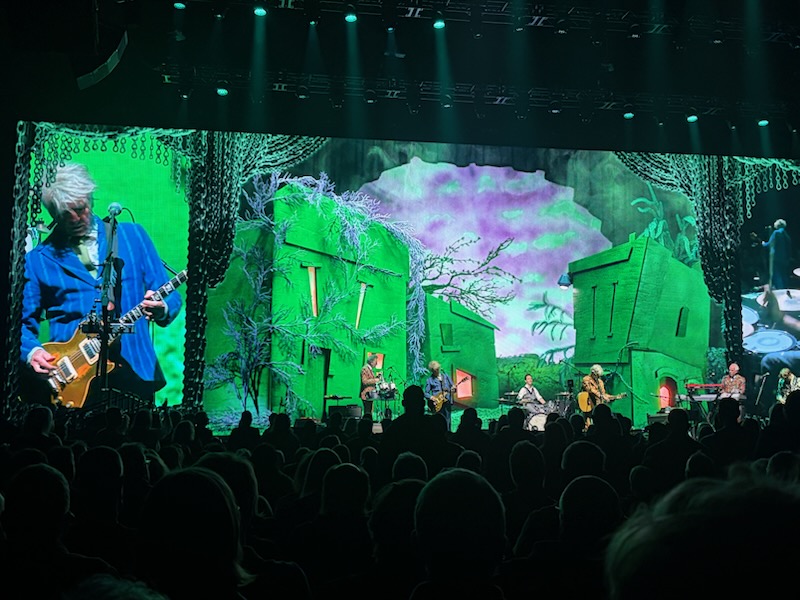
Fifty years. As T.S. Eliot wrote – our beginnings never know our ends. And who would have thought that such a whimsically ambitious project as Split Enz would be embarking on another victory lap celebrating fifty years of strangeness, arthouse sight and sound, and particoloured pop.
When, in the early 70s, I first saw a clip of Split Enz on GTK featured on ABC-TV just before the news hour, it seemed to me that this weird Kiwi band had somehow not received the style memo. Mistaking their off-kilter costumes and contorted choreography for Failed Glam, I wondered how on earth they got to be the opening act for Roxy Music -themselves just beginning their meteoric rise to Ferrydom.
It was only sometime in 1975 when I actually saw the Enz live. In the Matthew Flinders Theatre at Flinders Uni, for a lunchtime concert when touring their debut album, Mental Notes. To a crowd of maybe a hundred they delivered a full-dress performance. The band of seven, led by song writers Tim Finn and (the long-departed, now beleaguered) Phil Judd, with Eddy Rayner on keyboards, and Noel Crombie on costume design, living tableau, and spoons.
Everything about them was extraordinary and outlandish. The baggy pastel suits, the garish makeup, and the surreal topiary hairstyles- extruded into the twin peaks of Crombie, or, in Finn’s case, a pompadour with shaven sides that looked like a danger to low flying aircraft. Who, I wondered, in the pre-Punk, early Glam period (when hair was the epicentre of culture) would commit such travesty ?
The music was equally and brilliantly perverse with its fractured melodies, contorted tempos and convulsive rhythms, executed with antic precision and sung in a mix of recitative and suppressed panic. The songs - “Under the Wheel”, “Stranger than Fiction” and “Time for a Change” rang out as the players shifted and shuffled like the chorus in Peter Brook’s Marat/Sade.
This was the avant end of the avant garde. How good that members of Skyhooks saw them in Melbourne and phoned up Michael Gudinski - who promptly signed them up. And stuck with them through the financially bumpy, but highly creative, ride - until the arrival of Finn the Younger, and in 1980, the blazing hit success of True Colours.
Dialling forward five long decades, and Split Enz are again taking the stage at the Adelaide Entertainment Centre. It is the last show of their Forever Enz tour of Australia and New Zealand, playing to arena crowds – including two nights in Sydney and three in their adopted home base, Melbourne.
After a captivating opening set from Vika and Linda (capably backed by surefire trio, The Bullettes) showcasing new songs from their forthcoming album, Where do You Come From ? - it is time to begin, and the band to make their Enztrance.
The faded theatrical curtain (itself a digital simulacrum) parts like the Red Sea, an unwieldy polythene-wrapped heffalump blunders on to the stage, and from it (a reprise of the One Out of the Bag show for their 30th birthday in 2006) comes spilling the six members of the current iteration of Split Enz.
Of course they are wearing classic Crombie creations. Tim Finn (looking rather like Oscar Wilde) is dressed in brown with orange and blue windowpane designs, Eddy Raynor is in red and grey, Neil Finn sports blue and light blue stripes, and Noel Crombie has chosen a copper-coloured herringbone. They all spread across the stage in Vistavision against the massive digital screen which features an ever-morphing, brilliantly eccentric mess-en-scene which envelopes and illuminates the show for the next two hours.
Instead of the stark rectangular video closeups usual in music events the backdrop is festooned with all manner of unfathomable imagery. The soloists are surrounded by curtains of metal chain, there are projections of mesas and canyons like something David Lynch would conjure for National Geographic. There are coloured sprays of stage lighting and wisps of fog. Suddenly the images become Gormenghastly or like slime green Broomhilda cartoons. It is phantasmagoric eye candy.
The set begins on the front foot as Tim Finn leads in, head bobbing, snapping the lyrics of “Shark Attack”. The whole band is on red alert. Rayner jabbing the keyboard, Neil Finn hitching his guitar with purpose, and the much younger ring-in rhythm section – James Milne on bass and drummer Matt Eccles - laying down a formidable foundation for the entire show.
“History Nevers Repeats” follows – patently incorrect, given that Neil’s vocal is proving these songs (augmented by the crowd singalong) have never sounded fuller and better. “Poor Boy” from True Colours shines richly, Tim then continuing at the piano with “Give it a Whirl” and after an ominous Rayner keyboard intro, bursting into his mantra against depression - “Dirty Creature”.
“Time for a Change” is a return to the debut album, Mental Notes and a sole credit for Phil Judd. Tim’s solo piano and keening vocal is followed by a tsunami of Pink Floyd-esque chord changes and one of many searing guitar solos from Neil. Time for a change indeed. Melancholy doubt is then displaced by the upbeat “One Step Ahead”, roaring through the crowd, eager for the pop hits in large and stunningly clear 21st century arena sound.
They are also revelling in the plaintive Finn ballads – “Message to My Girl”, later, the tender “Stuff and Nonsense” and in the encore, “I Hope I Never”. Neil leads on several, although Tim’s singing in the final stages of the show (and in what is the band’s 1,113th performance over half a century) is starting to strain. Like McCartney, a once almost uniquely pure tone is quietly shredding in latter days, But it is even the more acclaimed by the Enz faithful, many dressed in replica costumes and draped in brand new merch. No Enz Days for them.
This splendid concert has many highlights. Eddy Rayner’s mid-set instrumental from True Colours, “Double Happy” is a definite. While he works his stack of keyboards with thrilling gusto, surrounded by a seismic rhythm section, the huge screen displays a myriad of Noel Crombie’s stage costume designs, arrayed like a regiment of psychedelic troops with the cameras then swooping in close enough to show the buttons, the stitching, the wit and whimsy of fifty years of theatrics. As Tim Finn declares- “We never had to worry about what to wear on stage.”
As they appear, the singles stir old memories – the Countdown clips and the radio rotations when Gudinski and the band began to gain the attention and payoff they deserved. “My Mistake”, “I Got You”, “I See Red” – turbocharged with the rich sound and still nimble vocals.
Fittingly the final song is “Strait Old Line” and His Crombieness makes a memorable cameo. Always key to the band semiotic, his droll other-worldly demeanour remains a delight. Standing all night at his percussion desk, he has added string whistles, pattering snare drums, and - amidst the thunder of electricity - resolutely tapped his triangle. His is the last word - follow the straight old line. And, after this concert’s joyful cacophony – his is the final note. The sound of two spoons clapping. This was no ordinary night.
Split Enz played at the Adelaide Entertainment Centre on May 25, 2026.
Published InDaily InReview May 26, 2026.
Ursula Yovich Sings Nina Simone
Published: 2026-06-06
Adelaide Cabaret Festival
Banquet Room
Aided and abetted by an excellent band, Ursula Yovich not only showcases the work of a musical legend, she artfully brings the lessons of the songs closer to home.
Written by Murray Bramwell
The more time passes, the more amazing is Nina Simone. Her musical gifts as both composer and performer are extraordinary and unique. Her legacy has been clouded in recent times with the preoccupation with the mental distress in her later years. The Netflix documentary What Happened, Miss Simone ? may have graphically reported on her decline, but it could not conceal her genius and commanding presence.
In 1970, Nina Simone confided to a New York audience how tiring performing had become - and that she hoped that night’s live recording (released as Black Gold) would be something people could still listen to when she was gone.
And what remarkable treasures those albums now are, especially the concerts when her precision and gift for improvising across genres and styles is so apparent. Apart from her own brilliant compositions, there are the covers – Broadway tunes, spirituals, blues standards, Bob Dylan, Leonard Cohen, Joni Mitchell, George Harrison and Burt Bacharach songs– all transmuted into Nina Simone originals.
In her captivating Cabaret Festival tribute, Ursula Yovich fondly recalls, as a youngster in Darwin, watching Simone video clips on Rage. That admiration has grown into a profound sense of kinship, an affiliation with this singer, and her willingness to bear witness. “It is the artists’ duty ,” says Yovich, “to reflect the times.” And she applauds Nina Simone as an artist, an activist, and “The High Priestess of Soul”
After an extended and outstanding career as both actor and singer, Yovich has in some ways echoed Simone’s own. Identified for exceptional talent she enrolled in theatre and music classes when very young. And her impressive bio includes more than 50 stage productions, including her own compositions, one person shows, high profile Australian films and TV, and multiple Helpmann and other prestigious awards- including, as of last Thursday night the Adelaide Gala Cabaret Icon award.
As soon as Ursula Yovich and her terrific four piece band take to the stage, the packed house in the Banquet Room is ready to roll. The show opens with ‘Sinnerman’, the diminutive Yovich filling the air with her powerful contralto, ‘Sinnerman where are you going to run to ?’ She doesn’t mimic Simone but is clearly a match for the repertoire.
Her vocal is urgent and in lock-step with the roiling piano and the snap sharp snare drum. The repetitions -call and response of “Power”- set a revival mood, but also syncopated handclapping and piano rhythms remind us that Nina Simone hearkened to such jazz stylings as Dave Brubeck’s ‘Unsquare Dance’.
In immediate contrast comes ‘Black is the Colour of My True Love’s Hair’, Simone’s variation on the widely revived Scottish ballad. With only piano accompaniment from Daniel Pilner, Yovich effortlessly captures the tenderness of the Highland original - but also the celebration of Black identity.
In the first of a number personal commentaries on the material chosen, she recalls first hearing the song and feeling she could at last cast off the crushing connotations of Black as “ugly and evil and dark.” It remains quietly implicit in this version, however, unlike the variation Nina Simone also recorded which proudly asserted- “Black is her body/ so firm and so bold/ Black is beauty/Her soul is gold.”
The pairing of Jacques Brel’s ‘Ne Me Quitte Pas’ with Gershwin’s ‘I Loves You Porgy’ which follows is not so much a mash-up as a sublime pairing of two compositions brought delectably to life. Ursula Yovich’s effortlessly phrased vocal captures not only the pensive Brel, but the gently mournful lilt and swing of Gershwin.
An almost reggae beat for ‘Don’t Let Me be Misunderstood’ brings a tempo change and the band get into stride. Musical director and bass player Adam Ventoura adds chorus vocals, and guitarist Daniel March contributes tasty flourishes also. The song’s title leads Yovich to reflect on the alienation and indifference of misunderstanding.
Throughout the performance, in the manner of Nina Simone, she reflects on the chaos and cruelty of the larger world and also within our own borders. By saying the quiet stuff out loud, she bears witness to racial injustices - not with generalities, but the names of First Nations men and women who have suffered and died with no consequence for the perpetrators.
This leads into the most confronting song in the setlist. ‘Strange Fruit’ a graphic depiction of two racist lynchings (written by Abel Meeropol and made famous by Billie Holliday and Nina Simone) opens with slow-march dirge chords on piano - and Ursula Yovich’s penetrating vocal. “Strange fruit hanging from the poplar trees/ Pastoral scenes from the gallant South.” It is, and should be, a grim pause in the proceedings.
Lovich and her excellent band then swing into Simone’s portraits of discrimination and defiance ‘Four Women’ and the upbeat hymn from the hippie musical, Hair ‘Ain’t Got No/I Got Life’ followed by Nina Simone’s most celebrated anthem (co-written by Weldon Irvine) ‘To be Young, Gifted and Black’, which took its title from a phrase coined by the African American playwright, Lorraine Hansberry. It could also describe the accomplishments of Ursula Yovich herself.
‘Stars’- Janis Ian’s musing on celebrity and self-worth, has the line “Truth tellers don’t fade” leading Yovich to celebrate and lament the tribulations of people such as Nelson Mandela and Charlie Perkins, among others. This segues into a concern for artists in a hostile world, and, in her own case as an actor, immersed in performances depicting and protesting dire human predicaments that are no more resolved now than ever. “Truth doesn’t protect you,“ she observes. “It can isolate you instead.”
Never letting the occasion to become fretful, however, Ursula Yovich and the band turn to another of Nina Simone’s rallying calls for revolution – ‘Everything Must Change’ –“nothing remains the same”. It is musically exhilarating, the players all lifting Yovich’s soaring vocal – Daniel Pilner on the ivories, Daniel March turning out tasty guitar riffs, Fabian Hevia on drums, closely matching Adam Ventoura on bass. These players can turn on a dime.
The final number is Nina Simone’s open question, about liberty and freedom from persecution, ‘I Wish I Knew How it Feels to be Free.’ For many of us in the audience it is probably not a statement we properly comprehend. Certainly not in the way that Ursula Yovich does. It has been her gift to the festival not only to engage generously, but to memorably conjure up the amazing music of a pioneer whose day is still ahead of us.
Ursula Yovich Sings Nina Simone plays one more performance in the Banquet Room, Saturday June 6 at 7pm.
Published InDaily June 6, 2026
Monsieur Camembert: Cohen Noir
Published: 2026-06-20
Adelaide Cabaret Festival
In another Cabaret Festival highlight, the excellent Monsieur Camembert celebrate the unique appeal of Leonard Cohen, and display their own musical flair in the telling.
Written by Murray Bramwell
“Ring the bells that still can ring/Forget your perfect offering/There’s a crack in everything / that’s how the light gets in.”
The poetic lines from Leonard Cohen’s ‘Anthem’ reverberate for the many admirers who have accumulated since he first swapped poetry for the Tower of Song with his debut album in 1967.
But in 2004, things had seriously cracked for Cohen himself. It was discovered that his manager, Kelley Lynch, had not only totally looted his life savings, but had sold off his publishing rights and artist royalties. Years of gruelling, largely futile, legal conflict were to follow.
In 2008, however, a whole lot of light shone in for fans everywhere. Cohen embarked on a series of world tours, not only hugely restoring his finances, but, at age 74, re-igniting his musical creativity.
Many in Adelaide will recall his Leconfield winery concert in January 2009 (I still have the ticket) and his return fixture at Thebarton the following year. Dapper in his suit and fedora, surrounded by a band of mostly Canadian talent, Leonard charmed and soothed and amused and captured audiences.
He also paved the way for more septuagenarian (now eighty something) legends to take up travelling minstrelsy, playing to the old crowd but also the new one. He may have been a sportsman and a shepherd (and a lazy bastard living in a suit) but he had created his own Renaissance.
Apart from live concert releases, Cohen recorded more albums – the marvellous Old Ideas and Popular Problems, the aptly named You Want it Darker (released just three weeks before his death in November 2016) and the posthumous Thanks for the Dance released in 2019.
Looking around, and over-hearing, the sell-out crowd at the Dunstan Theatre eagerly awaiting Cabaret Festival headliners Monsieur Camembert, it is evident that this is a chance to renew connection with Cohen’s music and persona – and also, perhaps, the precious and vivid memory of those peerless concerts earlier this century.
Monsieur Camembert’s number one cheese and co-founder, Yaron Hallis, calls this latest version of their Leonard shows (which began way back in 2007}, Cohen Noir. And, perhaps with more light than shade, it is a splendidly fashioned immersion in the life, works, and wry wisdom, of a remarkable poet musician.
With more years span than Brel or Gainsbourg, and more immediacy than Dylan, Leonard Cohen has described life in the seventh age, evoking memoranda from past lives, bringing old ideas and popular problems. As well as dance music with one foot in the grave. Or, maybe - eternity.
The first voice of the night we hear is Leonard Cohen himself. One of many fragments spread at intervals throughout the performance. Intriguing excerpts from interviews, speculations, confessions, aphorisms, jokes, and self-deprecations.
Sitting on a bar stool in a striped cap and a Leonard Cohen merch T-shirt under his jacket, leader, MC, vocalist and owlish narrator Yaron Hallis begins to croon – “If you want a lover …” The ten piece band saunters and swings, does the ragtime slowly. It is ‘I’m Your Man’ – one of many of Cohen’s slyly raffish musical masks, and a perfect opener for the set.
With “Where is my Gypsy Wife tonight ?” Hallis shifts the mood to Cohen dread – of rejection, and uncertainty. “This is the darkness. This is the Flood”. Matthew Ottignon provides mournful bass clarinet and Susie Bishop steps forward with a simmering violin solo.
In addition to Hallis’s well-judged, gruff low-key, Leonard vocals (which are never impersonations) Cohen Noir features four guest vocalists. Lyn Bowtell’s melodically expansive reading of ‘Bird on a Wire’ lifts the musical stakes and reminds us that the focus is not only on Cohen’s poetic lyrics, but the pleasure of his tunes. Bowtell unleashes her range with memorable effect.
Another early highlight follows. ‘Who by Fire’, the composition love child of Cohen and Janis Ian, opens with bowed bass from Mark Harris and more sublime piano from Daniel Pilner (who was also terrific in the band for Ursula Yovich’s Nina Simone tribute at the festival two weeks ago.) The singer is Timothy James Bowen. Bearded, with steel framed glasses, in denim and a Stetson hat, he captures in his keening vocal the very flame of one of Cohen’s great songs.
Then it is Susie Bishop’s turn to shine. Ushered in with Pilner’s trickling piano she sings –“It’s four in the morning …” Famous Blue Raincoat – famously covered by Jennifer Warnes and others - is made Bishop’s own. The band gradually joins – drums, a soaring sax solo on perfect cue – and then the curt, epistolary ending, “Sincerely, L. Cohen. “
The fourth singer, Diana Rouvas brings further vocal variation with a jazzy take on abject Leonard’s ‘Light as a Breeze’. Her agility and gospel inflections and phrasing nicely working the impish ironies between words and music.
The band returns with a breakneck jive take on ‘Jazz Police’ from the 1988 I’m Your Man album. They are a well-oiled unit, moving the focus among the players Charlie Meadows on jaunty guitar, a bass solo and scat attack from Mark Harris, and concluding with a saxophone seizure from Matthew Ottignon.
A set of Cohen songs has a multitude to select from and Monsieur Camembert choose well. Guided by pattering brushstrokes from Cameron Reid, strings and basslines, Timothy James Bown strums the opening lines of ‘So Long Marianne’- later to be joined with a dazzling violin solo from Ben Adler . Susie Bishop’s ‘Joan of Arc’ is a haunting slow blues with call and response from Yaron Hallis which rises, without excess, to operatic crescendo.
And the trio of Bowtell, Rouvas and Bowen doowop and sashay through ‘Memories’ another boisterous glimpse of Cohen’s view of courtship as the comedy of desperation.
For the final section of the two hour show, the fifty person Adelaide choir, Born on Monday (led by Ella and Anthony Pak-Poy) fill the stage to add majestic voice for a succession of Leonard Big Ones.
Lyn Bowtell’s reading of ‘If it Be Your Will’ is a lovely opener especially with the addition of a Mongolian throat singing interlude from band member Bukhu.
And of course, with fifty extra voices on hand there’s going to be ‘Hallelujah’, Cohen’s most covered song and, in the process – after Jeff Buckley, k.d.lang, John Cale, Willie Nelson, the execrable Rufus Wainwright, and every second contestant for The Voice – has lost some of its subtlety and satiric Cohen edge.
It is now unassailably “anthemic”, but tonight, astutely shared by Bowtell, Rouvas, Bowen and Bishop, and the harmonic full strength choir, it is reflective rather than bombastic - and an undoubted crowd favourite.
As is ‘Everybody Knows’. If ever a song spoke to the times, it is this paeon to outrage and profound disappointment, posing as cynicism. We sang the repeated mantra with some exhilaration. Everybody Knows. We see you.
The music is upbeat samba. Meadows sprightly Django on guitar, more scat from Harris, klezmer violin from Bishop. And a singalong, clap-along ending.
“A song is an anchor thrown into a foaming sea” Another Leonard observation comes from the disembodied ether. Present in another form. Time for ‘Anthem’. Ring the bells that still can ring, that crack in everything, the light let in.
Diana Rouvas sings it beautifully, the choir surges, and we cut away to Bukhu again. His throat singing singing is indescribably compelling, as is his solo on the ancient horsehair fiddle. The segue to Matthew Ottignon’s saxophone effortlessly lets even more music in.
So, there is nothing left but to Dance to the End of Love, which Monsieur Camembert, amiably and capably led by Yaron Hallis, proceed to do. It is the place to depart. Cohen in his late concerts made much of it, as he did ‘Anthem’.
It is another Leonard paradox. Very near the end, Yaron Hallis tells us, Cohen declared himself ready for death. A little later he corrected himself, saying maybe he was exaggerating. Whatever, he mused – “You’ll be hearing from me, Baby.” We certainly did tonight.
Cohen Noir, presented by Monsieur Camembert, has one more performance at the Dunstan Theatre on April 20 at 7.45 pm.
Published in InDaily InReview June 20, 2026,